


In global steel trade, tens of thousands of steel products cross international borders every day. From hot-rolled coil to seamless steel pipe, and from structural steel to precision alloys, each product has its own HS code. This seemingly simple code precisely defines the product’s category, characteristics, and value, and serves as the fundamental basis for determining whether goods can clear customs smoothly, how much duty must be paid, and whether they comply with trade agreements.
HS codes serve as the core basis for customs clearance, tariff assessment, and trade compliance. While the first six digits of the code are standardized internationally, subsequent subheadings vary by country’s tariff schedule. This results in differing tariff rates for the same steel product across different importing countries and is often linked to trade remedy measures such as anti-dumping duties. From the practical perspective of international trade buyers, this special feature systematically outlines the classification of steel products under HS codes, differences in codes across countries, common error risks, and strategies for mitigation, providing you with a clear and practical quick-reference guide and compliance manual for HS codes in cross-border steel procurement.
1. What Is the HS Code, and Why Is It Important for Steel Imports and Exports?
The HS Code (Harmonized System Code), formally known as the “Harmonized System of Nomenclature and Coding,” is an internationally recognized commodity classification system established by the World Customs Organization (WCO). It is widely used in customs administration, trade statistics, and rules of origin determinations in more than 200 countries and regions worldwide, serving as a fundamental tool for identifying goods in international trade.
Each HS code is a unique identifier assigned to a product category. These codes not only describe what a product is; they also determine its taxability, whether it is subject to restrictions, and whether it qualifies for preferential tariffs under a Free Trade Agreement (FTA).
In the international trade of steel, HS codes serve as the foundation for accurate communication among trading parties, logistics carriers, and customs authorities. Correct classification not only affects the application of tariffs, the determination of country of origin, and the accuracy of regulatory requirements, but also directly impacts the efficiency of customs clearance and compliance costs. In international steel procurement, understanding and correctly applying HS codes is a fundamental prerequisite for effective collaboration between buyers and suppliers.
2. Structure of the HS Code
The HS code is the universal language of global trade. The World Customs Organization maintains the Harmonized System. More than 200 countries use the same first six digits (HS 2022 edition, which will be the globally accepted version in 2026) to describe traded goods; national customs authorities extend these codes beyond the six-digit level, resulting in differences among national coding systems. For example, China typically uses 10-digit customs commodity codes for import and export declarations; the United States adds four more digits for imports, resulting in a 10-digit HTS code; and the European Union uses the TARIC system to further determine tax rates, regulatory conditions, and trade measures.
Encoding position | meaning | Approaches to Understanding |
Top 2 | Chapter | Internationally recognized. There are 97 chapters in total (77 of which are left blank), corresponding to 21 major industry categories (category numbers 1–21); however, category numbers and chapter numbers are assigned independently and do not correspond to one another (for example, Category 21 contains Chapter 98). The first two digits of the code directly indicate the chapter number (e.g., 72 = steel). |
3rd–4th | Heading | Internationally recognized. Within each chapter, products are classified by major categories and subcategories (e.g., plates, pipes, and profiles). Based on the current 2022 edition of the HS, there are a total of 1,241 four-digit headings worldwide. |
5th–6th | Subheading | Internationally recognized. Subcategories are further classified under each heading based on specific specifications, materials, or uses. According to the current 2022 edition of the HS, there are a total of 5,019 six-digit subheadings worldwide. |
7th–8th | Domestic Subcategory | Determined by each country (e.g., China’s domestic subcategories). Based on the six-digit international standard code, countries further refine the classification according to their own tariff and statistical needs. |
9th–10th | Additional Number | Determined by each country. Further subcategories based on specific regulatory requirements in each country (such as inspection and quarantine, anti-dumping duties, and statistical records). |
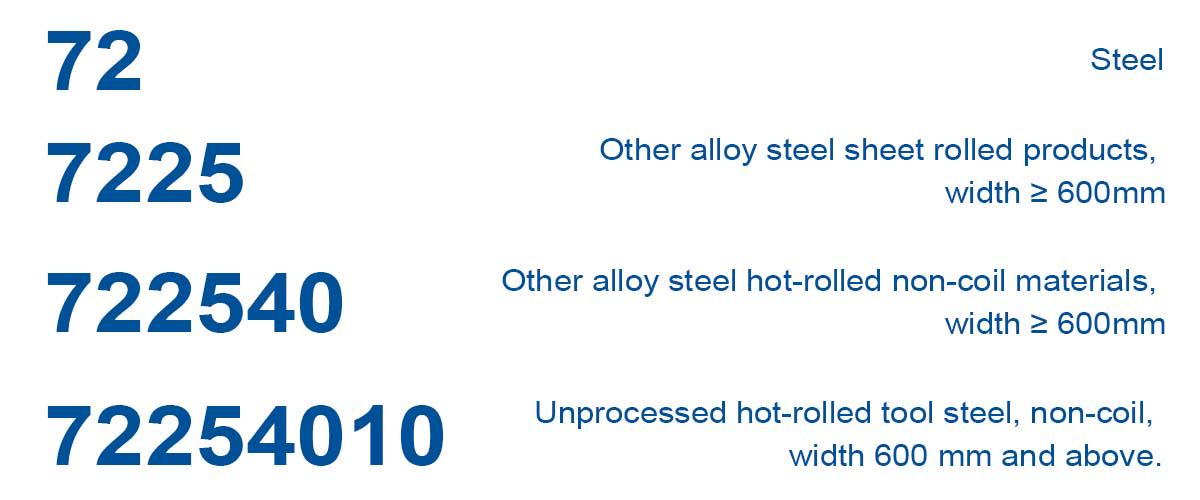
HS codes consist of a six-digit structure, with the first two digits corresponding to the chapter to which the commodity belongs (e.g., Chapter 72 covers iron and steel and their products), the third and fourth digits representing the heading, which distinguishes major categories of commodities (e.g., plates, tubes, or profiles), and the fifth and sixth digits representing the subheading, which corresponds to specific product specifications and attributes. This hierarchical structure ensures accuracy. The first six digits ensure global identification, while the additional digits meet the requirements of individual countries regarding tax rates and regulatory controls.
Take 722540 as an example: The first four digits, 7225, specify the product category as other alloy steel flat-rolled products with a width of 600 millimeters or more, while the last two digits, 40, further indicate that the product is in a hot-rolled condition and has not undergone specific processing such as cladding, plating, or coating (typically corresponding to specifications with a thickness greater than 10 millimeters). Through this coding system, customs authorities in various countries can uniformly identify and classify imported and exported goods, enabling efficient coordination in regulation, statistics, and taxation.
3. The Difference Between Export Codes and Import Codes
During inspections, customs authorities operate based on the HS codes of their respective countries.
Dimensions of Comparison | Export Clearance | Import Clearance |
Definition | The process of declaring goods to customs and completing clearance procedures before they leave the country | The process of declaring the goods to customs and completing import procedures after they arrive in the destination country |
Purpose | Ensure that the goods are exported legally and in compliance with the regulations of the exporting country | Ensure that goods enter the country legally and comply with the importing country’s regulations |
Declarant | This is typically the responsibility of the exporter (seller). | This is typically the responsibility of the importer (buyer/consignee). |
Regulatory Priorities | Verify whether the goods fall under the country’s export prohibition or restriction categories, and whether there has been any tax evasion, underreporting, or misreporting. | Verify import compliance requirements and review HS codes and declared prices to determine the tax base. |
Process Sequence | Booking → Cargo Preparation & Stuffing → Export Customs Declaration → Customs Document Review → Goods Inspection (if required) → Payment of Export Duties (if applicable) → Customs Release → Cargo Departure | Cargo arrival at port → Delivery Order exchange → Import customs declaration → Customs review, classification & valuation → Payment of duties & taxes → Inspection & quarantine (if required)→ Customs release → Cargo pickup |
Tariff Flows | Tariffs belong to the exporting country. | Tariffs belong to the importing country. |
Factors Affecting Timeliness | Efficiency of Domestic Customs and Tax Refund Review | Importing country’s market access policies, inspection rates, and speed of tax and fee payment |
Key Risk Areas | Failed Tax Refund, Export Ban Penalty | Higher-than-expected taxes and fees, goods detained by customs, or goods returned or destroyed due to failure to meet inspection and quarantine standards |
Inspection by the Exporting Country (e.g., China): Chinese customs inspections are based on the 10-digit HS code declared in the export declaration. In other words, when filing an export customs declaration, the information you submit and the code you declare must comply with Chinese customs regulations; this is key to ensuring the smooth export of goods.
Inspection by the Importing Country: Once the goods arrive in the importing country, that country’s customs authorities conduct inspections based on its own HS codes. For example, when goods enter the European Union, EU customs authorities review and inspect them according to the EU’s HS codes. In such cases, the HS code used by the importer may differ from the HS code used for export from China, but this does not affect the legality of customs clearance. As long as the first six digits match, the goods can clear customs normally and qualify for a tax refund in accordance with regulations.
However, sometimes discrepancies between the HS codes for exports and imports may lead to questions from the importing country’s customs authorities or requests for further inspection. If the first six digits of the classification are incorrect, this generally constitutes a fundamental classification error, which can trigger multiple risks: domestically, it may be deemed a false declaration, affecting export tax rebates; internationally, it may result in customs detention, inspections, tariff disputes, and fines, causing delays in customs clearance. To avoid such situations, both trading parties should focus on the following measures:
a.Prior Communication: Before exporting, communicate thoroughly with the importer/exporter to ensure both parties have a consistent understanding of the goods’ classification and codes.
b.Consistency in Documentation: Ensure that the descriptions of the goods on relevant documents (such as contracts, invoices, and packing lists) are clear and consistent. This helps customs officials understand the true nature of the goods and reduces complications during inspections.
c.Reasonable Explanation: If the customs authorities in the importing country have questions regarding discrepancies in the HS codes, the importer can explain the rationale for these discrepancies to customs based on the specific characteristics of the goods and the documentation provided by both parties.
For commodities such as steel, the accuracy of classification is particularly important. Subtle differences in manufacturing processes and specifications—such as whether the steel is hot-rolled or cold-rolled, whether its width exceeds 600 millimeters, and whether it is alloy steel—all correspond to different HS codes, which in turn entail significantly different tariff rates and regulatory requirements. Below is a quick reference table of HS codes for common steel products:
HS Code Classification of Steel Products (Quick Reference Table)
Chapter 72 covers steel, and Chapter 73 covers steel products; items in black text are common products, while those in green are less common.
Due to the large number of codes involved and space limitations, the table lists only the first four digits of the internationally recognized HS codes. You can look up the full six-digit HS codes yourself using the following link: https://www.wcotradetools.org/en/harmonized-system/2022/en
HS Code | Product Name |
7201 | Pig iron and spiegeleisen in pigs, blocks or other primary forms. |
7202 | Ferro-alloys. |
7203 | Ferrous products obtained by direct reduction of iron ore and other spongy ferrous products, in lumps, pellets or similar forms; iron having a minimum purity by weight of 99.94 %, in lumps, pellets or similar forms. |
7204 | Ferrous waste and scrap; remelting scrap ingots of iron or steel. |
7205 | Granules and powders, of pig iron, spiegeleisen, iron or steel. |
7206 | Iron and non-alloy steel in ingots or other primary forms (excluding iron of heading 72.03). |
7207 | Semi-finished products of iron or non-alloy steel. |
7208 | Flat-rolled products of iron or non-alloy steel, of a width of 600 mm or more, hot-rolled, not clad, plated or coated. |
7209 | Flat-rolled products of iron or non-alloy steel, of a width of 600 mm or more, cold-rolled (cold-reduced), not clad, plated or coated. |
7210 | Flat-rolled products of iron or non-alloy steel, of a width of 600 mm or more, clad, plated or coated. |
7211 | Flat-rolled products of iron or non-alloy steel, of a width of less than 600 mm, not clad, plated or coated. |
7212 | Flat-rolled products of iron or non-alloy steel, of a width of less than 600 mm, clad, plated or coated. |
7213 | Bars and rods, hot-rolled, in irregularly wound coils, of iron or non-alloy steel. |
7214 | Other bars and rods of iron or non-alloy steel, not further worked than forged, hot-rolled, hot-drawn or hot-extruded, but including those twisted after rolling. |
7215 | Other bars and rods of iron or non-alloy steel. |
7216 | Angles, shapes and sections of iron or non-alloy steel. |
7217 | Wire of iron or non-alloy steel. |
7218 | Stainless steel in ingots or other primary forms; semi-finished products of stainless steel. |
7219 | Flat-rolled products of stainless steel, of a width of 600 mm or more. |
7220 | Flat-rolled products of stainless steel, of a width of less than 600 mm. |
7221 | Bars and rods, hot-rolled, in irregularly wound coils, of stainless steel. |
7222 | Other bars and rods of stainless steel; angles, shapes and sections of stainless steel. |
7223 | Wire of stainless steel. |
7224 | Other alloy steel in ingots or other primary forms; semi-finished products of other alloy steel. |
7225 | Flat-rolled products of other alloy steel, of a width of 600 mm or more. |
7226 | Flat-rolled products of other alloy steel, of a width of less than 600 mm. |
7227 | Bars and rods, hot-rolled, in irregularly wound coils, of other alloy steel. |
7228 | Other bars and rods of other alloy steel; angles, shapes and sections, of other alloy steel; hollow drill bars and rods, of alloy or non-alloy steel. |
7229 | Wire of other alloy steel. |
7301 | Sheet piling of iron or steel, whether or not drilled, punched or made from assembled elements; welded angles, shapes and sections, of iron or steel. |
7302 | Railway or tramway track construction material of iron or steel, the following : rails, check-rails and rack rails, switch blades, crossing frogs, point rods and other crossing pieces, sleepers (cross-ties), fish-plates, chairs, chair wedges, sole plates (base plates), rail clips, bedplates, ties and other material specialized for jointing or fixing rails. |
7303 | Tubes, pipes and hollow profiles, of cast iron. |
7304 | Tubes, pipes and hollow profiles, seamless, of iron (other than cast iron) or steel. |
7305 | Other tubes and pipes (for example, welded, riveted or similarly closed), having circular cross-sections, the external diameter of which exceeds 406.4 mm, of iron or steel. |
7306 | Other tubes, pipes and hollow profiles (for example, open seam or welded, riveted or similarly closed), of iron or steel. |
7307 | Tube or pipe fittings (for example, couplings, elbows, sleeves), of iron or steel. |
7308 | Structures (excluding prefabricated buildings of heading 94.06) and parts of structures (for example, bridges and bridge-sections, lock-gates, towers, lattice masts, roofs, roofing frame-works, doors and windows and their frames and thresholds for doors, shutters, balustrades, pillars and columns), of iron or steel; plates, rods, angles, shapes, sections, tubes and the like, prepared for use in structures, of iron or steel. |
7309 | Reservoirs, tanks, vats and similar containers for any material (other than compressed or liquefied gas), of iron or steel, of a capacity exceeding 300 l, whether or not lined or heat-insulated, but not fitted with mechanical or thermal equipment. |
7310 | Tanks, casks, drums, cans, boxes and similar containers, for any material (other than compressed or liquefied gas), of iron or steel, of a capacity not exceeding 300 l, whether or not lined or heat-insulated, but not fitted with mechanical or thermal equipment. |
7311 | Containers for compressed or liquefied gas, of iron or steel. |
7312 | Stranded wire, ropes, cables, plaited bands, slings and the like, of iron or steel, not electrically insulated. |
7313 | Barbed wire of iron or steel; twisted hoop or single flat wire, barbed or not, and loosely twisted double wire, of a kind used for fencing, of iron or steel. |
7314 | Cloth (including endless bands), grill, netting and fencing, of iron or steel wire; expanded metal of iron or steel. |
7315 | Chain and parts thereof, of iron or steel. |
7316 | Anchors, grapnels and parts thereof, of iron or steel. |
7317 | Nails, tacks, drawing pins, corrugated nails, staples (other than those of heading 83.05) and similar articles, of iron or steel, whether or not with heads of other material, but excluding such articles with heads of copper. |
7318 | Screws, bolts, nuts, coach screws, screw hooks, rivets, cotters, cotter-pins, washers (including spring washers) and similar articles, of iron or steel. |
7319 | Sewing needles, knitting needles, bodkins, crochet hooks, embroidery stilettos and similar articles, for use in the hand, of iron or steel; safety pins and other pins of iron or steel, not elsewhere specified or included. |
7320 | Springs and leaves for springs, of iron or steel. |
7321 | Stoves, ranges, grates, cookers (including those with subsidiary boilers for central heating), barbecues, braziers, gas-rings, plate warmers and similar non-electric domestic appliances, and parts thereof, of iron or steel. |
7322 | Radiators for central heating, not electrically heated, and parts thereof, of iron or steel; air heaters and hot air distributors (including distributors which can also distribute fresh or conditioned air), not electrically heated, incorporating a motor-driven fan or blower, and parts thereof, of iron or steel. |
7323 | Table, kitchen or other household articles and parts thereof, of iron or steel; iron or steel wool; pot scourers and scouring or polishing pads, gloves and the like, of iron or steel. |
7324 | Sanitary ware and parts thereof, of iron or steel. |
7325 | Other cast articles of iron or steel. |
7326 | Other articles of iron or steel. |
4. Differences in coding standards across countries and tariff risks (same product, different tax rates)
As mentioned earlier, the first 6 digits of the HS code are a globally unified commodity classification standard. However, the codes after the sixth digit are refined by each country according to its own regulatory and taxation needs. This means that the applicable tariff rates and regulatory requirements may be completely different when the same product is imported into different countries. The same steel products may be classified under different tariff codes in different importing countries due to different coding extension rules, thus subjecting them to vastly different tariff rates. Some steel products are also subject to trade measures such as anti-dumping duties and safeguard duties, and these additional tax burdens are often deeply tied to specific HS codes. A single error in coding can lead to minor issues like overpayment of customs duties and customs delays, or even serious consequences such as customs administrative penalties or being classified as smuggling.
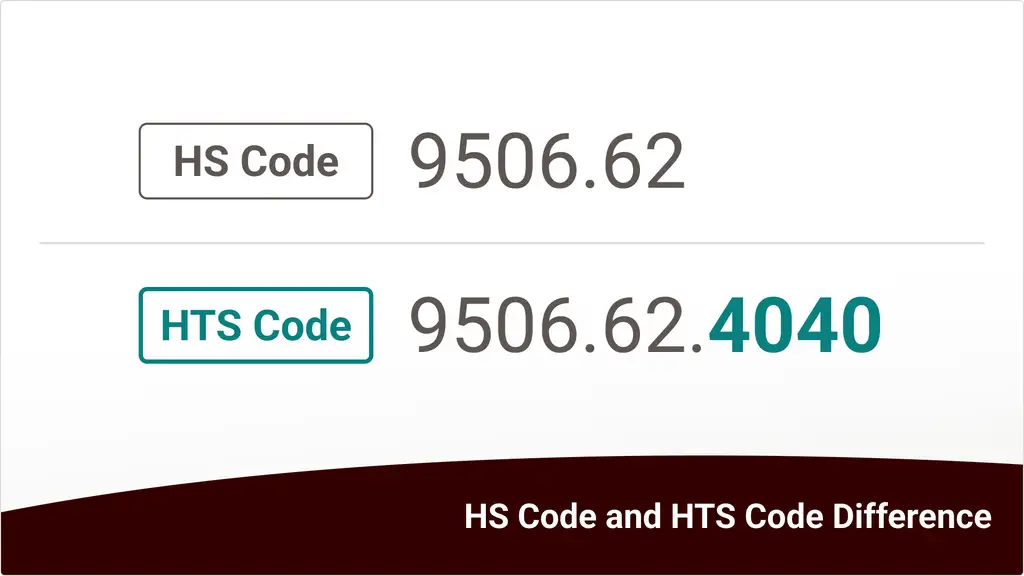
Different countries have different ways of expanding upon the HS coding system. Currently, the United States uses a 10-digit HTS coding system. Since August 2025, it has terminated the low-value goods exemption policy, and all steel imports must be declared using the complete 10-digit HTS code. The EU uses an 8-digit CN code, and customs can further use a 10-digit TARIC code for more detailed management. The member states of the South American Common Market (Brazil, Argentina, Uruguay, Paraguay, and Venezuela) use the NCM code, which consists of 8 digits. The first 6 digits are the same as the HS code, while the last 2 digits provide more specific commodity classification information, enabling member states to more accurately identify and manage trade flows within the region. In addition, Australia uses the 8-digit AHECC code, ASEAN member states use the 8-digit AHTN code, and Hong Kong uses the 8-digit HKHS code.
In addition, countries may revise the codes according to their own policy needs—for example, the EU recently adjusted the CN code for products such as galvanized bars (7215.10).
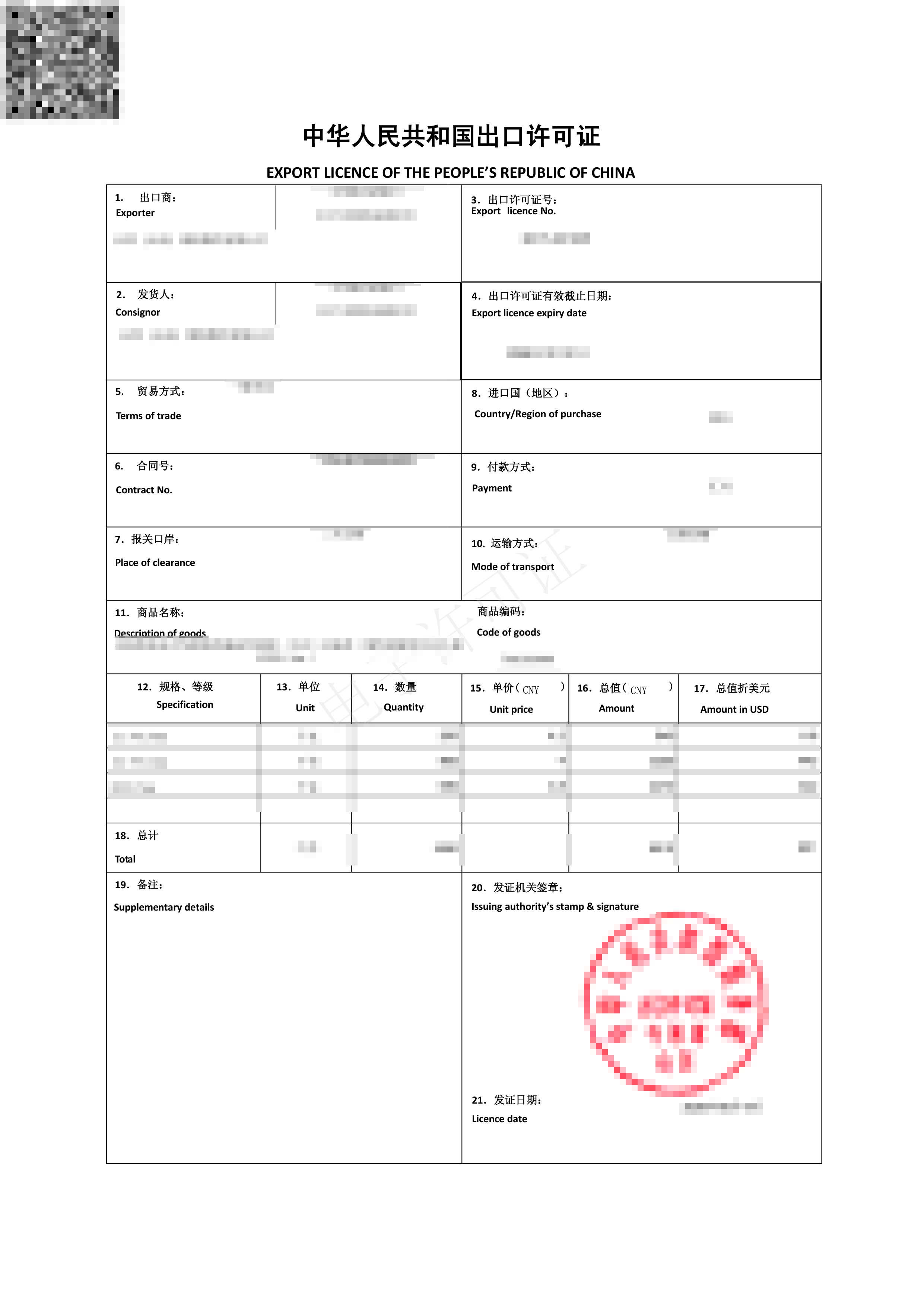
International buyers should also pay special attention to recent changes in China: starting from January 1, 2026, the Ministry of Commerce and the General Administration of Customs will include 300 types of steel and steel products in the "Catalogue of Goods Subject to Export License Management". Chapter 72 requires export licenses for almost all products (except ferroalloys); Chapter 73 also includes 76 products with ten-digit codes under items 7301-7307. Exporting companies must apply for a license based on the export contract and the manufacturer's quality inspection certificate.
Taking rebar under 7214 (bars and rods of ferrous or non-alloy steel) as an example, products with the same first 6 digits of the code face completely different tariff burdens in the Chinese, American, European Union, and Indian markets. In the US market, the benchmark most-favored-nation tariff rate for some 7214 subheading products is 0%, but all bars and rods listed under tariff headings 7213, 7214, 7215, 7227, and 7228 are subject to an additional 25% Section 232 tariff. In June 2025, the United States further increased the Section 232 tariffs on some steel products from 25% to 50%. For steel products originating from China, additional tariffs under Section 301 and IEEPA are also required. Based on comprehensive calculations, the total tariff burden on Chinese-origin rebar entering the US market can reach over 70%. The EU market implements a quota system, with a 25% safeguard duty levied on steel products imported outside the quota, and the annual increase in the quota has been reduced from 1% to 0.1%. The EU has approximately 18.3 million tons of steel that can be imported duty-free each year. Once the quota is exhausted, all additional imports are subject to a 25% tariff. It is worth noting that the EU recently discovered that since 2025, a large number of imports that should have been classified under 7214 20 00 and 7214 99 10 (steel reinforcement products) have been reclassified under 7228 30 69 (alloy steel bars). This portion of imports accounts for approximately 35% of the total annual steel reinforcement quota in 2025, and the EU has launched an investigation into this type of circumvention. In the Indian market, in 2025, India will impose anti-dumping duties on certain alloy and non-alloy steel flat products originating from or exported from China (involving HS codes 7208, 7211, 7225, 7226, etc.), which will be valid for five years. At the same time, it will impose a 12% provisional safeguard duty on certain steel products.
The same first 6 digits of the code result in significant differences in tariff treatment across the three major markets of the US, Europe, and India—the US has a combined tariff rate of over 70%, the EU has an extra-quota tariff of 25%, and India is subject to a combination of anti-dumping and safeguard measures. This difference means that international buyers must confirm the complete tariff codes and applicable tax rates of the destination country before making a purchase, and cannot simply extrapolate the tariff costs of one market to another. Classification and tariff decisions are directly related to the controllability of procurement costs, and mistakes can have consequences far exceeding expectations—the next section will further illustrate this with specific examples.
5. Common HS encoding errors and their consequences
Inaccurate HS code declarations are one of the most common compliance risks in international steel trade. Whether due to misunderstandings of classification rules, misjudgments of product attributes, or attempts to circumvent tariffs or fraudulently obtain tax refunds by changing codes, the consequences can far exceed expectations. The following outlines several typical coding errors and their consequences from both export and import perspectives.
Error Type | Explanation | Typical Steel Industry Cases | Major Legal / Economic Consequences |
Export side: Misclassification of goods with a low export tax rebate rate under a HS code enjoying a higher rebate rate | Different HS codes correspond to different export tax rebate rates. Declaring goods with a low or zero actual rebate rate under a HS code entitled to a higher rebate rate constitutes an illegal act impairing state export tax rebate administration. | Misdeclaration of steel pipe fittings and steel structural components as deep processed products | Fines ranging from 10%-50% of the declared value; supply delays |
Import side: Misclassification of high tax rate goods under a low tax rate code | During import clearance, declaring goods subject to a higher actual customs duty rate under a HS code with a lower duty rate constitutes an illegal act impairing state tax collection. | Misdeclaration of HS codes for stainless steel billets and alloy steel bars (e.g. declaring a code with an actual 6% tax rate under a 4% rate code) | Fines ranging from 30% of the evaded tax amount up to twice the evaded tax; port of discharge detention and warehousing charges |
Circumvention: Altering chemical composition / HS code to evade anti-dumping duties or import quotas | This carries the highest risk among HS classification violations in international trade and requires close vigilance from overseas importers. | Minor adjustment of rebar chemical composition to evade EU steel safeguard measures | Full penalties borne by the importer, including back tax payments and fines, revocation of import privileges, and potential criminal liability |
Misclassification between raw materials and finished products | For steel trade commodities, products of identical material composition may fall under completely different HS chapters depending on their processing stage. | Cross declaration between seamless steel pipes (Chapter 73) and fabricated steel structural parts (HS 7308) | Customs inspection and cargo detention, document rejection or amendment, adverse impacts on tax rebates and customs clearance |
Since 2025, some importers have slightly adjusted the chemical composition of rebar, changing products that should have been classified as 7214 20 00 and 7214 99 10 (steel bars, subject to safeguard quotas) to 7228 30 69 (alloy bars, subject to different quota categories). The European Commission confirmed that such imports exhibited a "quite unusual flow pattern" in 2025, with imports under item 7228 30 69 accounting for approximately 35% of the total annual steel reinforcement quota for 2025. In response, the EU amended its safeguard measures regulations in April 2026, adding two new TARIC subheadings, 7228 30 69 11 and 7228 30 69 99, to close the loophole. The US market also maintains a high-pressure stance against coding circumvention, with misclassification involving Section 232 tariffs potentially resulting in maximum fines and no exemptions.
US:
Under Title 19, Section 1592 of the United States Code, U.S. Customs and Border Protection (CBP) penalizes false or inaccurate declarations. This includes omitting material information that could alter the classification or valuation of goods, or concealing unfair trade practices or illegal acts. Using incorrect Harmonized System codes, whether intentional or unintentional, falls into this category.
As mentioned above, non-compliance penalties for such customs violations depend on the degree of fault alleged against the importer and whether customs duties were lost due to the violation, and can be categorized into several situations as shown in the table below. Furthermore, U.S. Customs and Border Protection (CBP) may also seize goods and pursue penalties secured by the importer's customs bonded goods.
Degree of Liability | Loss without Customs Duty | Loss with Customs Duty |
Negligence | 5-20% of the domestic value of the goods | 50-200% |
Gross Negligence | 25-45% | 250-400% |
Fraud | 50-80% | 500-800% |
European Union:
Incorrect declarations will result in customs debts. Member state customs authorities will pursue outstanding duties in accordance with the law, usually with late payment interest. In addition, additional late payment penalties may be levied under the domestic laws of each member state. Specific penalty amounts vary by member state, and the legal framework is summarized and assessed in reports published by the European Commission. Repeated or intentional violations will face higher fines and may trigger a post-clearance audit, reviewing declaration records from previous years.
United Kingdom:
HM Revenue and Customs (HMRC) will handle violations such as misclassification under the Customs (Import Duty) (EU Exit) Regulations 2018 and the Customs and Excise Management Act 1979.
The consequences of violations include:
a.Recovery of unpaid taxes: HMRC will recover all customs duties and import VAT that were underpaid due to misdeclaration.
b. Financial penalties: Fines are categorized according to the severity of the violation:
Careless: A maximum fine of 30% of the potential tax loss may be imposed.
Deliberate: If the misdeclaration was intentional to evade customs duties, HMRC may impose a civil evasion penalty of up to 100% of the unpaid customs duties.
In addition, for some violations, a fixed fine ranging from £250 to £2,500 may be imposed for each error.
c.Other enforcement measures: In addition to fines, HMRC has the right to seize goods and even initiate criminal proceedings for serious violations.
6.Practical Recommendations for Importing Steel
Before importing steel products, accurately determining the HS code and the applicable tariff rate is the essential foundation for compliant customs clearance. The following practical recommendations are designed to help international buyers systematically mitigate risks and optimize costs.
6.1 Articles made of steel fall under Section XV – Base Metals and Articles of Base Metal, which includes Chapter 72 (Iron and Steel) and Chapter 73 (Articles of Iron or Steel). When preparing to import steel from China, it is critical to become familiar with the tariff schedules for both chapters.
Useful HS code lookup databases:
EU: https://www.tariffnumber.com/
US: https://www.trade.gov/customs-info-database-user-guide
China: https://www.hsbianma.com/
6.2 Determine the HS Code at the Enquiry Stage
Do not wait until the goods arrive at the destination port to consider the HS code. Instead, clarify the HS code during the enquiry and contracting phase. Request the supplier to provide material certificates, detailed product specifications, and processing methods. For complex shapes such as profiles and special-shaped sections, provide product images or drawings to your customs broker or freight forwarder to obtain a pre-classification confirmation before shipment. This helps avoid operational errors later.
6.3 Fully Calculate Tariff Costs
The HS code directly determines the import duty rate. International buyers must pay special attention to anti-dumping duties and countervailing duties (CVD), which are often the biggest “hidden killers.” For more information on anti-dumping, please refer to the Anti-dumping Special Topic. Many buyers only focus on the basic tariff and overlook the potential high additional taxes that may arise from the country of origin, which can drive total costs up by 20%–50%. It is essential to verify whether the steel’s origin is subject to frequent anti‑dumping investigations. Before signing a contract and making payment, always check the following for the destination country based on the HS code: Most‑Favoured‑Nation (MFN) duty, anti‑dumping/countervailing duties, safeguard measure surcharges, and CBAM costs. Perform a comprehensive calculation of the total landed cost.

6.4 Risks of Supplier Misclassification
For international buyers, incorrect classification by the supplier may lead to:
Goods being detained or returned due to discrepancies between the declared code and the actual product, resulting in customs refusal to release the cargo;
Additional duties and penalties: supplementary payment of the duty difference, plus fines of 5%–30% of the value of the goods;
Loss of export tax rebates: an incorrect code could reduce the export rebate rate from 13% to 0%;
License/permits violations: declaring a product that requires a license under a code that does not require one constitutes a regulatory violation.
As mentioned earlier, effective from 1 January 2026, China has included 300 steel and steel product categories in the Catalogue of Goods Subject to Export License Administration — almost all products under Chapter 72 (except ferroalloys) and 76 ten‑digit HS codes under headings 7301‑7307 of Chapter 73 require an export license. Exporters must apply for the export license based on the export contract and the manufacturer’s quality inspection certificate. Inaccurate declarations that affect license management may result in penalties ranging from 5% to 30% of the value of the goods.
6.5 Contractual Protections and Insurance
In the procurement contract, explicitly stipulate that the supplier shall bear all additional costs and losses arising from errors in HS code classification. At the same time, international buyers are advised to purchase specialised trade compliance insurance.
Steel trade policies change frequently. International buyers should continuously monitor updates to HS codes and tariff policies in each country. Consider subscribing to policy bulletins from the destination country’s customs authority or trade department. CSMC will also closely track policy changes in various countries and provide timely updates.
We sincerely hope that the information we provide can make more beneficial value. In addition, we sincerely invite you to leave valuable comments and advice on our website. We will follow up on your comments and advice at any time on our website.
CSMC - Empowering small and medium-scale steel purchasing.
Editor: Hana Kyra
Mail: cs@chinasteelmarket.com



|

|

|

|

|
| Timely Info | Independent | Platform | Multiple guarantees | Self-operated storage |
China Steel Market
Empowering small and medium-scale steel purchasing
| About us | Channel | Useful tools |
|---|---|---|
| About China Steel Market | Prices | Steel Weight Calculation |
| Contact Us | Answers | Why Choose Us |
| Terms & Conditions | Inventory | |
| Privacy Policy | Help |
Hot search words:
China Rebar prices China Wire Rod Prices Welded Steel Pipe Prices