


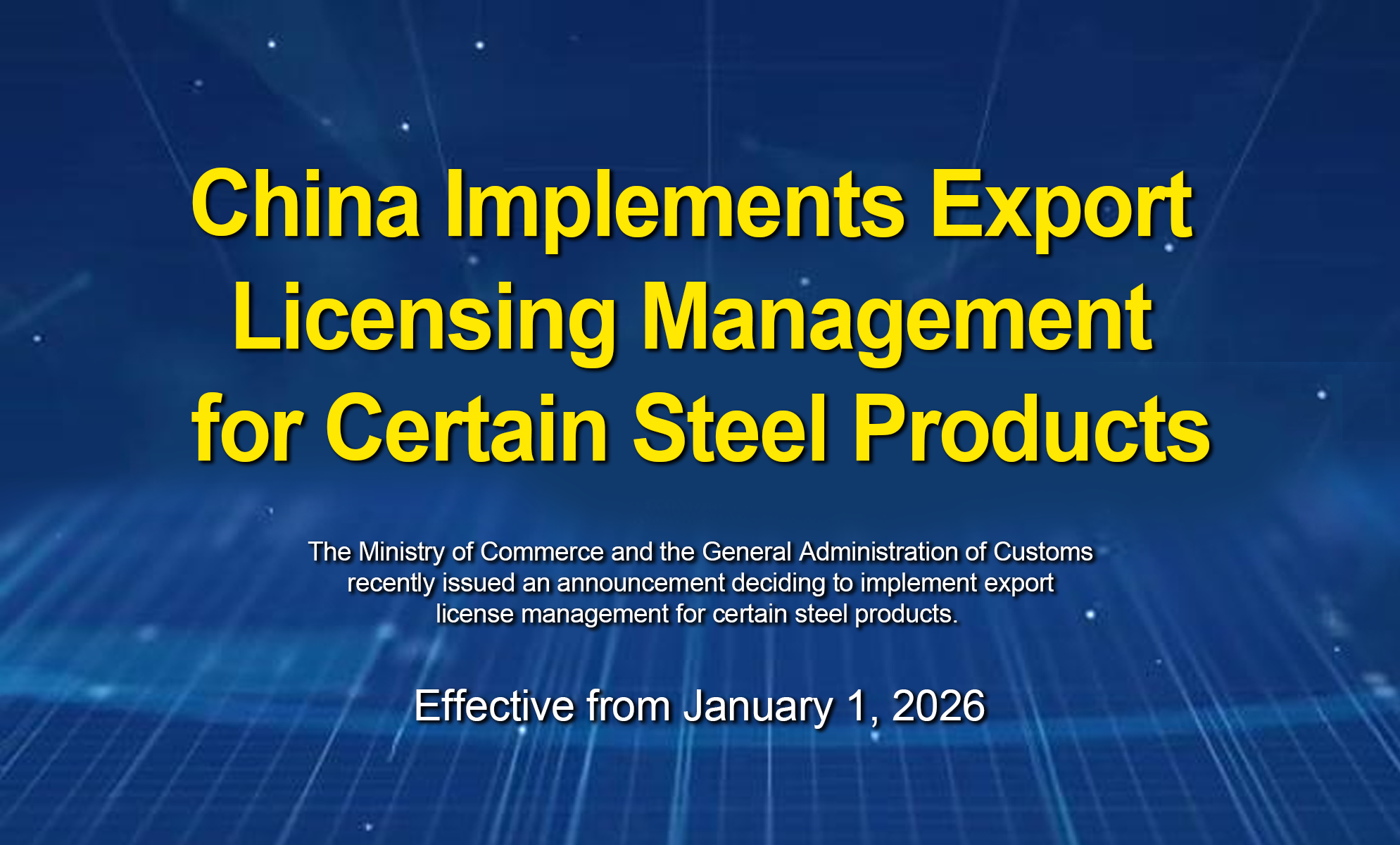
On December 12, 2025, the Ministry of Commerce and the General Administration of Customs jointly issued Announcement No. 79, deciding to implement export license management for certain steel products starting from January 1, 2026.
This is the re-implementation of the steel export license system in China 16 years after it was abolished in 2009, signifying a new stage in China's steel export management.
The China Iron and Steel Association stated that the current inclusion of steel products in the export license management system is an important measure to guide the standardized export of steel products and promote the high-quality development of the steel industry, which is conducive to maintaining the global steel supply and demand pattern and trade balance.
The China Iron and Steel Association (CISA) stated that continuously improving the management of steel product exports is a key step in ensuring that steel products meet domestic demand first in the process of my country's accelerated construction of a new development pattern. It is also a necessary measure for my country to guide industrial upgrading domestically and participate in international supply chain cooperation in the context of globalization. This will help coordinate trade flows, integrate trade channels, promote positive interaction between international and domestic markets, and ultimately achieve the transformation and upgrading of the steel industry.
According to Announcement No. 79, steel products subject to export license management encompass 300 customs commodity codes, covering the entire industrial chain from raw materials to finished products.
In September 2025, the Ministry of Industry and Information Technology, together with the Ministry of Natural Resources, the Ministry of Ecology and Environment, the Ministry of Commerce, and the State Administration for Market Regulation, jointly issued the "Work Plan for Stabilizing Growth in the Steel Industry (2025-2026)," which clearly proposed to strengthen the management of steel product exports, maintain the order of export competition, and optimize the structure of steel export products. Announcement No. 79 is a concrete measure to implement this requirement.
Chen Leiming, executive chairman and secretary-general of the China Metal Materials Circulation Association, told YICAI reporters that this policy adjustment is a necessary measure to address the multiple challenges currently facing the steel industry.
From January to November 2025, China's steel exports reached 107.7 million tons, a year-on-year increase of 6.7%. The total export volume for the year is expected to reach 115 million tons, exceeding the historical high of 112 million tons in 2015.
However, structural contradictions still exist behind the growth in export volume, manifested in declining export prices and a surge in exports of low-value-added primary products. Chen Leiming stated that this "volume-based price reduction" export model not only increases energy consumption and carbon emissions but also easily triggers more international trade frictions, which is inconsistent with the long-term goal of high-quality development of my country's steel industry.
According to data from the General Administration of Customs, my country's steel exports reached 58.15 million tons in the first half of 2025, a year-on-year increase of 9.2%; the average export price was US$699.3 per ton, a year-on-year decrease of 10.3%; and the export value was US$40.66 billion, a year-on-year decrease of 2.0%. In the first half of 2025, my country exported a total of 5.89 million tons of steel billets, three times that of the same period last year, while the average export price decreased by 15.3%.
"The surge in billet exports but the decline in prices in the first half of 2025 reflects that some companies are still in the early stages of price competition. Export license management will increase the compliance costs of exporting low value-added products, forcing companies to adjust their product structure," said Chen Leiming.
In addition, the steel industry has experienced a significant increase in trade friction cases. Since 2024, China's steel industry has faced more than 50 anti-dumping cases, a record high. Vietnam, India, South Korea, Indonesia and other countries have successively imposed anti-dumping duties on Chinese hot-rolled steel coils, medium-thick steel plates and other products, with the highest tax rate reaching 38.02%.
License management can also guide enterprises to optimize their export market layout, reduce their reliance on traditional markets that have already imposed high anti-dumping duties, and expand into emerging markets such as Africa and Latin America.
Chen Leiming suggested that enterprises should promptly understand the specific product catalogs included in the management and prepare application materials such as export contracts and product quality inspection certificates in advance. Starting from December 15, 2025, companies can apply for licenses for 2026, and should plan ahead as early as possible. Steel companies should increase their investment in research and development and develop high-end products such as high-performance bearing steel, gear steel, and high-temperature alloys. Some leading domestic companies have begun exporting "green steel" products, obtaining EPD (Environmental Product Declaration) through full-process carbon verification, which reduces carbon emissions by 50% per ton of steel, this transformation is worth learning from.
Export License Application Guide
Attachment: List of Some Steel Products Subject to Export License Management.xls




|

|

|

|

|
| Timely Info | Independent | Platform | Multiple guarantees | Self-operated storage |
China Steel Market
Empowering small and medium-scale steel purchasing
| About us | Channel | Useful tools |
|---|---|---|
| About China Steel Market | Prices | Steel Weight Calculation |
| Contact Us | Answers | Why Choose Us |
| Terms & Conditions | Inventory | |
| Privacy Policy | Help |
Hot search words: