
03/07/2026
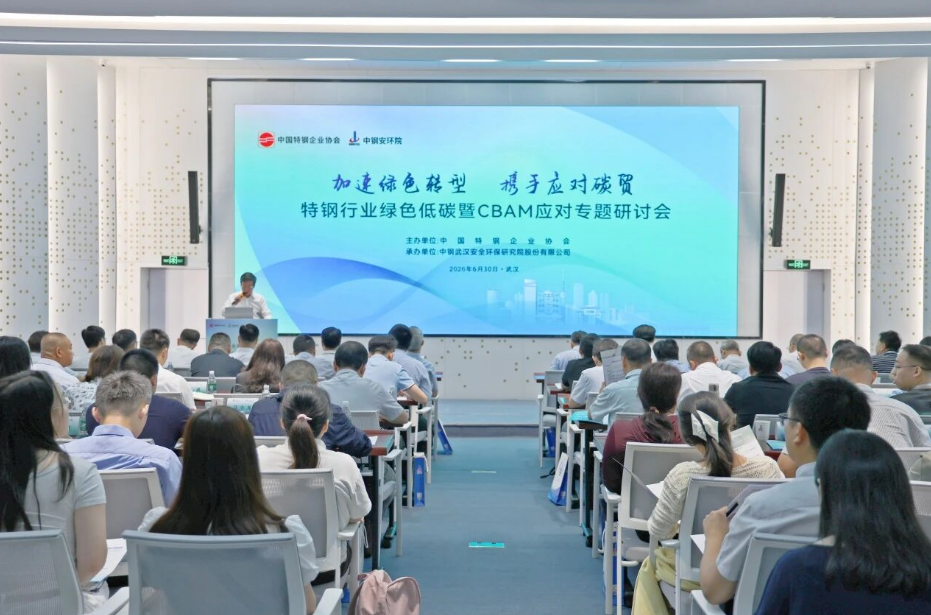
A seminar on the special steel industry’s response to the CBAM was held in Wuhan
This seminar focuses on the carbon tariff challenges facing China’s special steel industry following the formal implementation of the EU’s Carbon Border Adjustment Mechanism (CBAM). It features in-depth discussions on carbon accounting, compliance reporting and pathways to low-carbon transition.
Read More
29/04/2026
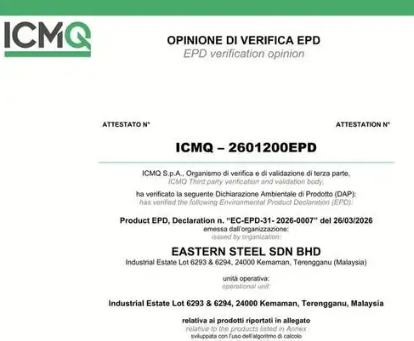
Malaysian Dong Steel's Hot-Rolled Coils Successfully Passed the EPD Audit
Recently, the hot-rolled coil products of Donggang Malaysia, an overseas subsidiary of Jianlong Group, successfully passed the rigorous audit of the Italian ICMQ organization EPDItaly©.

Sea freight is less expensive and suitable for non-urgent, large-volume steel shipments. Air freight offers the fastest transit time but is more expensive and is often used for high-value or urgent replenishment. Large shipments often require special containers, such as open-top containers or flatbed containers. Containers need to secure the cargo to prevent shifting during transport. Container reinforcement services are also provided during transport, using professional lashing and support structures to reduce the risk of cargo damage.Import and export transportation requires customs declaration at the port of origin and customs clearance at the destination, requiring compliant documents and licenses. Some services support "door-to-door clearance," where the logistics company handles customs declaration, tax payment, and delivery at both ends, eliminating the need for the customer to deal directly with customs or freight stations. Furthermore, transport insurance can cover risks such as loss or damage, reducing business losses.
When reviewing the material list, you need to verify the basic information: the grade and specifications. This is the most basic step. The grade on the material list must match the grade you need.Confirm the batch correspondence: the heat number and batch number on the material list. Upon receiving the goods, it is essential to verify that the inkjet printing/labels on the actual items match the material list. This is crucial for tracing the origin of steel and ensuring that the "goods and documents match".Check the official seal and signature: The material certificate must have the manufacturer's quality inspection seal and the signature or seal of the quality inspector. If it is a photocopy, it must be stamped with the supplier's official seal and marked "Consistent with the original".Check for alterations: Any signs of alteration to critical information (such as performance data, specifications, batch numbers) should be considered invalid proof.Verify performance data: Chemical composition: Pay close attention to whether the content of elements such as carbon (C), silicon (Si), manganese (Mn), phosphorus (P), and sulfur (S) is within the range specified in the standard. In particular, if the sulfur (S) content is abnormally low but there is a lack of corresponding technological support, we should be wary of data falsification.Mechanical properties: Check whether the measured data such as yield strength, tensile strength, elongation, and impact energy meet the standard requirements. It should be noted that different testing methods may lead to different results.Special performance requirements: If the contract has special requirements (such as Z-axis performance, low-temperature impact toughness), the material list must have corresponding measured data, and cannot rely on vague markings.Verify authenticity and compliance: Use official channels for traceability: Many large steel mills (such as Baosteel, Shougang, and Taiyuan Iron & Steel) provide online quality assurance certificate query systems or anti-counterfeiting QR codes. These official channels should be used first for verification.Beware of "perfect" data: When a supplier's quote is 8%-10% lower than the daily average price of similar products published by CSMC, and the material list data is unusually "perfect" (all indicators are at the standard upper limit with no dispersion), this is often a precursor to fraud.Normal test data will have reasonable dispersion. If all the data is "perfect" and without any fluctuations, it may actually be a sign of artificial manipulation.On-site sampling and re-inspection: For imported steel, mixed batches of steel, or when there is doubt about the quality, an independent re-inspection should be conducted by a qualified third-party laboratory.
Common Specifications and Weight ReferenceThe weight per meter of hollow anchor bolts varies considerably depending on their specifications. Below are approximate references for some common models:25 mm diameter, 5 mm wall thickness: Approx. 3.8 kg/m28 mm diameter, 5.5 mm wall thickness: Approx. 4.3 kg/m30 mm diameter, 6 mm wall thickness: Approx. 5.2 kg/m32 mm diameter, 6.5 mm wall thickness: Approx. 6 kg/m
The nominal wall thickness of a 25mm hollow anchor bolt is typically 5mm (often marked as Φ25×5), which is the most common configuration in railway and national standard engineering projects.The national standard GB 50086-2015 requires that the wall thickness of hollow grouting anchor bolts should not be less than 5.0mm. This means that 5.0mm is the minimum requirement, and the actual product wall thickness can be higher.
China Steel Market
Empowering small and medium-scale steel purchasing
Hot search words:
China Rebar prices China Wire Rod Prices