
Wear-resistant steel plate, also known as high-strength wear-resistant steel plate, refers to steel plate products that achieve high surface hardness and excellent wear resistance through the addition of alloying elements and quenching and tempering (quenching and tempering) heat treatment.
The core function of wear-resistant steel plate is to provide protection in applications or parts requiring wear resistance, extending equipment life, reducing maintenance and downtime, and consequently reducing capital investment. Its wear resistance is more than three times that of ordinary carbon structural steel plates.
Wear-resistant steel plate belongs to the category of quenched and tempered alloy wear-resistant steel, which differs from welded composite wear-resistant steel. Welded steel plates have a harder wear-resistant layer but cannot be bent, while wear-resistant steel plates can be bent and welded to a certain extent. Furthermore, wear-resistant steel plate differs from weathering steel plate: wear-resistant steel plate primarily focuses on wear resistance, with moderate rust prevention; weathering steel plate primarily focuses on atmospheric corrosion resistance, but is not wear-resistant. The two are not interchangeable.
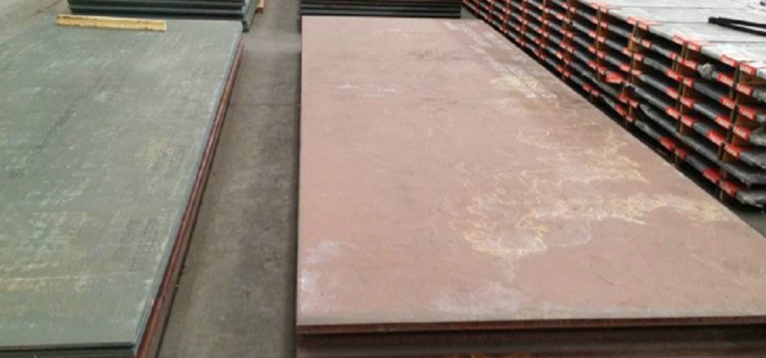
Domestic Grade Naming Rules
Wear-resistant steel plate grades follow the naming rule of "NM" + "number":
N: First letter of the pinyin for "wear-resistant"
M: First letter of the pinyin for "wear-resistant"
Number: Represents the nominal value of Brinell hardness (HBW)
Common Grades and Hardness Ranges
GB/T 24186 standard covers the following seven steel grades:
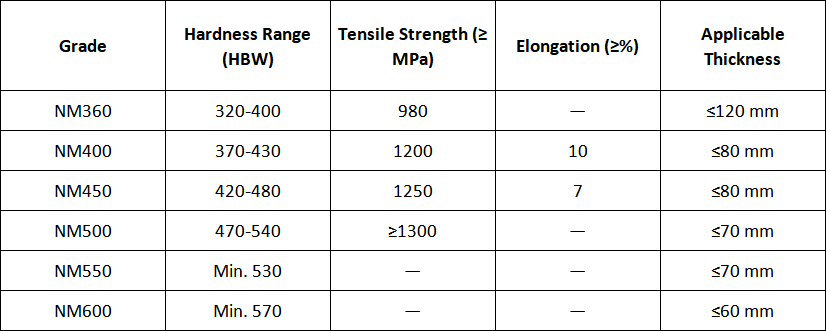
Wear-resistant steel plates use a low-carbon alloy system. Through a reasonable proportion of elements such as carbon, manganese, chromium, molybdenum, nickel, and boron, a hard structure is formed after heat treatment, achieving high surface hardness while balancing hardness and toughness.
Taking NM400, NM450, and NM500 as examples, their chemical composition requirements are as follows:

Core Performance Characteristics
1. High Hardness and High Wear Resistance
The most crucial performance indicator for wear-resistant steel plates is Brinell hardness (HBW). Hardness ranges from 320 HBW for NM360 to over 570 HBW for NM600, covering different wear conditions. Wear life is 4 to 8 times that of ordinary carbon steel.
2. High Strength
Abrasion-resistant steel plates also possess extremely high strength. For example, NM400 has a tensile strength ≥1200MPa; NM500 has a tensile strength ≥1300MPa. Its mechanical properties are 3 to 5 times that of ordinary low-alloy steel plates.
3. Certain Toughness
Abrasion-resistant steel plates have a certain degree of impact resistance, but ultra-high hardness grades are not suitable for withstanding huge impacts and are prone to cracking. Some high-performance abrasion-resistant steels can maintain low-temperature impact toughness at -40℃ or even -60℃.
4. Machinability
Abrasion-resistant steel plates support cutting, bending, welding, and other processing techniques. They can be cut into flat steel, angle steel, and other profiles. However, the higher the hardness, the greater the processing difficulty, and special processing measures are required during welding.
5. Cost-Effective:
Although weathering steel may initially cost more than traditional carbon steel, it can provide long-term cost savings due to its reduced maintenance requirements and the elimination of the need for periodic repainting.
6. Aesthetically Pleasing:
The naturally developed rust-like appearance of weathering steel plate creates a distinctive and aesthetically pleasing look, often used in modern architectural designs to blend with the natural environment.
7. Low Maintenance:
Weathering steel forms a self-repairing protective layer, which means maintenance is generally limited to periodic cleaning rather than extensive surface treatment.
8. Environmental Benefits:
Weathering steel is considered environmentally friendly since it reduces the use of protective coatings and prolongs the life cycle of structures, leading to lower resource consumption and waste generation.
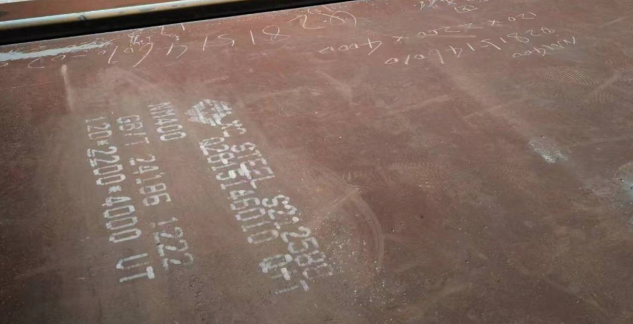
Delivery Status
Wear-resistant plates are uniformly delivered in a quenched + tempered state. Hot-rolled and unheated wear-resistant plates are not provided.
Main uses of weathering steel
As a new generation of steel raw materials, weathering steel has air corrosion resistance 2 to 5 times that of carbon structural steel, and the longer the service time, the more prominent the corrosion resistance effect. Because of its characteristics of rust resistance, spray-free, thinning, energy saving and consumption reduction, time saving, environmental protection and energy saving, it can be applied to steel frame structures that are exposed to the air for a long time, such as engineering buildings, vehicles, road bridges, and towers. To produce components such as shipping containers, railway vehicles, crude oil derricks, port engineering buildings, and oil production plant service platforms.
Cutting of weathering steel
When weathering steel is used, it needs to be cut, and it should also be designed and planned according to the engineering drawings. The material of weathering steel is relatively unique, the material is relatively good, it has relatively hard strength and toughness, and it plays a huge role in design and application!
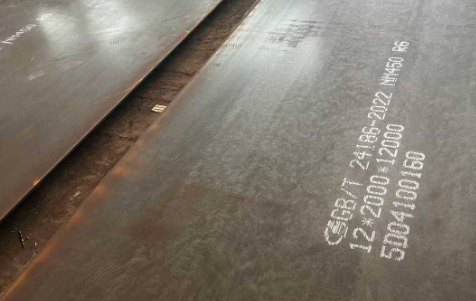
Weathering steel is a material of steel. It is a high-alloy steel (C<0.2%), with good comprehensive performance, good ultra-low temperature characteristics, good stamping characteristics, electric welding characteristics and good machinability. Widely used in highway bridges, vehicles, ships, engineering construction, high pressure vessels, etc. Q means the compromise of this material, and the 345 in the back refers to the compromise value of this material, which is around 345MPa.
It's important to note that while weathering steel plate provides excellent weather resistance, it may not be suitable for certain aggressive environments or conditions. Designers and engineers should consider the specific requirements of a project and consult relevant standards and guidelines before selecting weathering steel or any other construction material.
In China, weathering steel plates are commonly manufactured and specified in accordance with Chinese national standards, known as GB/T (Guo Biao Tuijian) standards. The main GB/T standard for weathering steel plates is:
GB/T 4171-2008: This standard specifies the size, shape, weight, technical requirements, test methods, inspection rules, packaging, marking, and quality certificates for weathering steel plates used in welded structures and other high-strength low-alloy structural steels.
GB/T 4171 includes several weathering steel grades, such as Q235NH, Q265GNH, Q295NH, Q310GNH, Q355NH, Q415NH, Q460NH, Q500NH, Q550NH, and Q600NH. Each grade is designed to provide enhanced resistance to atmospheric corrosion and is suitable for various structural and engineering applications in China.
Chinese weathering steel plates manufactured in compliance with GB/T 4171-2008 are known for their good mechanical properties and excellent weather resistance. They are widely used in bridge construction, railway vehicles, buildings, and other outdoor structures exposed to the elements.
When dealing with weathering steel plates in China, referring to GB/T 4171-2008 is crucial to ensure that the materials meet the required standards and specifications. Designers, engineers, and manufacturers should carefully select the appropriate weathering steel grade from this standard based on the specific project requirements, environmental conditions, and structural considerations.
It's important to note that while GB/T 4171-2008 is the primary national standard for weathering steel plates in China, other international standards, such as ASTM or EN, may also be referenced or used for specific projects in the country. However, GB/T 4171-2008 provides the comprehensive guidelines for weathering steel plates manufactured and used in China.
In the United States, weathering steel plates are typically manufactured and used in accordance with several industry standards and specifications that ensure their quality, performance, and suitability for various applications. Some of the key standards for weathering steel plates in the US include:
ASTM A588/A588M: This specification covers high-strength, low-alloy structural steel shapes, plates, and bars for welded, riveted, or bolted construction with atmospheric corrosion resistance. ASTM A588/A588M Grade A and Grade B are the most commonly used weathering steel grades in this standard.
ASTM A709/A709M: This specification covers carbon and high-strength low-alloy steel structural shapes, plates, and bars intended for use in bridges. The atmospheric corrosion resistance of the steel in most environments is substantially better than that of carbon structural steels with or without copper addition. ASTM A709/A709M Grade 50W is the weathering steel grade often used for bridges.
ASTM A242/A242M: This specification covers high-strength low-alloy structural steel shapes, plates, and bars for welded, riveted, or bolted construction intended primarily for use as structural members where savings in weight [mass] or added durability are important. ASTM A242/A242M Type 1 is the commonly used weathering steel grade in this standard.
These standards outline the chemical composition, mechanical properties, and other relevant characteristics of weathering steel plates. They also specify the testing and inspection methods to ensure the plates meet the required performance criteria.
In the United Kingdom, weathering steel plates are used and specified in accordance with various British Standards (BS) and European Standards (EN) that define the requirements for these materials. The most common standard for weathering steel plates in the UK is:
BS EN 10025-5: This European Standard specifies the requirements for flat and long products of hot-rolled structural steels with improved atmospheric corrosion resistance. It includes several weathering steel grades, such as S235J0W, S235J2W, S355J0WP, S355J2WP, S355J0W, S355J2W, and S355K2W.
BS EN 10025-5 outlines the chemical composition, mechanical properties, and delivery conditions for weathering steel plates intended for use in welded, bolted, and riveted structures subjected to atmospheric corrosion.
It's important to note that the UK often adopts European Standards (EN) as British Standards (BS EN) to harmonize with other European countries. Therefore, BS EN 10025-5 is the standard that should be referenced when dealing with weathering steel plates in the UK.
In Japan, weathering steel plates are commonly used and specified in accordance with Japanese Industrial Standards (JIS) that define the requirements for these materials. The main JIS standard for weathering steel plates is:
JIS G 3125: This Japanese Industrial Standard specifies superior atmospheric corrosion-resistant rolled steels. It includes several weathering steel grades, such as SPA-H, SPA-C, and SMA (e.g., SMA400AW, SMA490AW, SMA570W), which are designed to provide high resistance to atmospheric corrosion.
JIS G 3125 outlines the chemical composition, mechanical properties, dimensions, tolerances, and other relevant characteristics of weathering steel plates. These plates are primarily used in welded structures and other applications exposed to the elements in Japan.
When dealing with weathering steel plates in Japan, referring to JIS G 3125 is essential to ensure the proper material selection and compliance with industry standards. Designers, engineers, and manufacturers should carefully choose the appropriate weathering steel grade from this standard based on the specific requirements and environmental conditions of the project.
It is also important to note that Japan may use other international standards or specifications, such as ASTM or EN, for specific projects or applications. However, JIS G 3125 is the primary standard used in Japan for weathering steel plates, and it provides a comprehensive set of guidelines for these materials in various construction and engineering applications.

Copyright Notice © 2022 - 2023 ChinaSteelMarket.com All rights reserved.