
Wear-resistant steel plates, also known as abrasion-resistant steel plates, are specially designed and manufactured to resist harsh wear and impact conditions. These plates are made from high-quality steel alloys that have been hardened and treated to enhance their resistance against abrasion, erosion, and impact damage.
Processing of wear-resistant plates
Hot Cutting: Wear-resistant steel is suitable for various hot cutting methods, including oxy-fuel flame cutting, plasma cutting, and laser cutting. However, hot cutting can cause edge cracking, a delayed cracking form similar to weld cracks. The risk of edge cracking increases with the hardness and thickness of the steel plate. For thinner hot-rolled wear-resistant steel, reducing the cutting speed at low temperatures and preheating before cutting, followed by post-cut insulation and slow cooling, can reduce residual stress and prevent edge cracking.
Shearing: While high-strength wear-resistant steel can be sheared, the higher the tensile strength, the higher the shearing force required. Due to the high strength, shearing grades such as AR400 and AR450 is not recommended. When shearing, use a hard, sharp, and slightly rounded blade to ensure a quality cut surface. The blade gap should be adjusted according to the strength of the steel; higher-strength plates require a larger gap.
Bending Process: To prevent cracking due to workpiece hardening during bending, it is recommended to deburr the edges using a grinding machine. The longitudinal cold bending performance of steel plates is slightly better than that of transverse bending; therefore, in transverse bending, a slightly larger inner diameter is required for the same bending angle. The bending force can be calculated using specific formulas based on material properties.
Welding techniques and precautions: For welds of different grades, locations, and stress states, high-strength welding wire, as well as low-hydrogen welding methods and materials, are preferred. When using manual covered electrodes, alkaline electrodes should be selected.
For MAG welding, use a shielding gas mixture rich in argon (15-25%) and carbon dioxide at a flow rate of 10-25 liters/minute. Avoid vibrations during welding and use multi-pass and multi-layer techniques. It is recommended that the heat input for welding not exceed 10 kJ/cm to ensure a good weld appearance. Automation is preferred for long, straight welds.
Welding should be performed indoors at an ambient temperature not lower than 5°C. If the temperature drops below 5°C or the humidity is high, increase the minimum preheating temperature by 25°C.
The welding path should be strategically arranged to ensure the joint profile conforms to the geometry. The top height of the butt weld should not exceed 3mm, and dense staggered welds are prohibited.
Properties of wear-resistant steel plates:
The critical characteristic of wear-resistant steel plates is their ability to withstand repeated friction, impact, and scratching, therefore reducing downtime and maintenance costs. They offer excellent resistance to abrasive materials, such as rocks, ores, coal, minerals, and grains, which can cause significant damage to unprotected surfaces. These plates also exhibit high hardness, toughness, and strength, enabling them to resist deformation and maintain their structural integrity under demanding operating conditions.
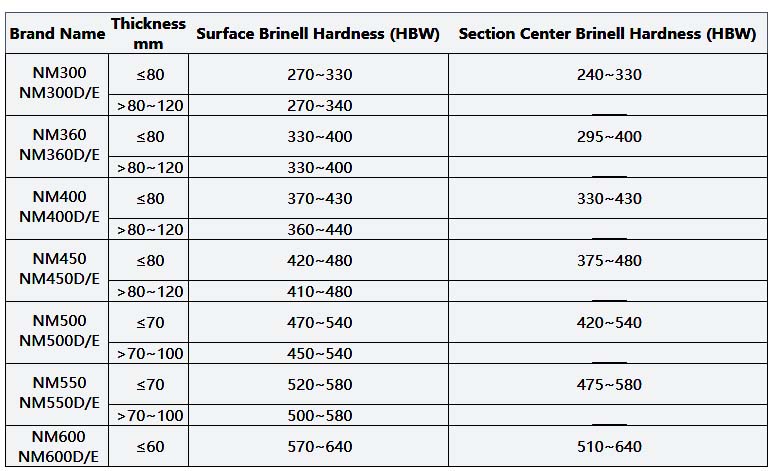
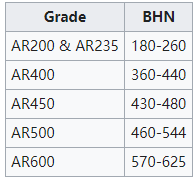
Hardness: The hardness of wear-resistant steel is maintained within a specified range. This hardness spectrum is crucial for achieving the optimal balance between wear resistance and toughness.
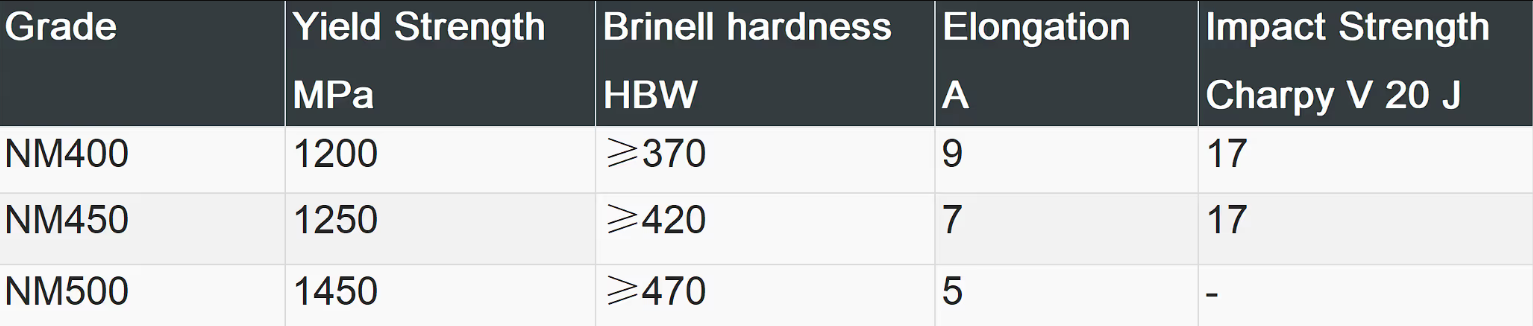
Composition: The composition of the alloy is measured to verify the presence of elements that contribute to the steel's wear resistance and other desired properties.

Application of wear-resistant steel plate:
Wear-resistant steel plates are commonly used in mining, construction, manufacturing, and material handling industries, where equipment and machinery are subjected to frequent wear, impact, and sliding abrasion. These plates provide a reliable and cost-effective solution to extend the lifespan and durability of critical components, such as buckets, chutes, crushers, hoppers, and conveyor systems.
Wear-resistant steel plates are available in various grades and thicknesses to cater to different application requirements. They can be easily fabricated and welded, allowing customized shapes and sizes to fit specific equipment or structures. Additionally, these plates can be further processed, such as bending, forming, cutting, or drilling, to suit different installation needs.
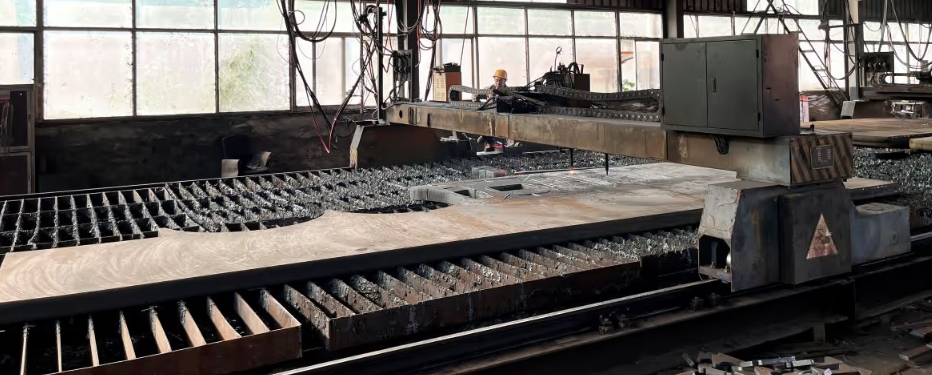
Overall, wear-resistant steel plates play a crucial role in protecting vulnerable components and structures from excessive wear and damage, thereby improving operational efficiency, reducing maintenance costs, and extending the service life of equipment in various industries.
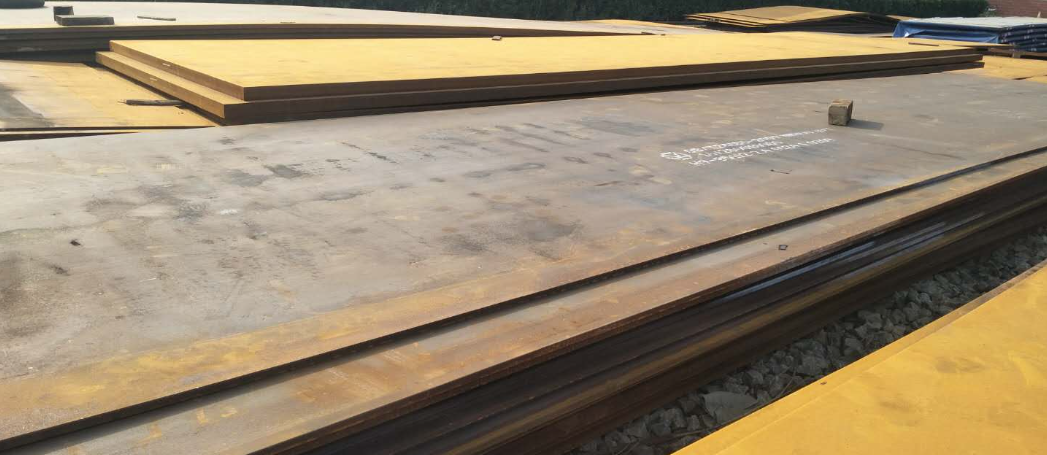
Because of the different countries where the steel is produced and the different uses of the wear plates, the governments of various countries have established various production standards for wear-resistant steel plates. According to the actual situation of this website, we are back to listing some common production standards for the reference of incoming buyers.
China Standard:
GB/T 24186-2022: High strength abrasion resistant steel plate,sheet and strip for construction machine.
This standard applies to single-rolled steel plates with a thickness not greater than 120 mm and steel strips and sheared steel plates with a thickness not greater than 25.4 mm for wear-resistant structural components of mining, construction, and agricultural construction machinery.
GB/T 3274-2017: Hot-rolled plates, sheets, and strips of carbon structural steels and high strength low alloy structural steels.
This standard applies to hot-rolled steel sheets and strips of carbon structural and low-alloy structural steels with a thickness not greater than 400mm.
American standard:
ASTM A514/A514M-13: Standard specification for high-strength wear-resistant alloy steel plates
ASTM A745/A745M-14(2020): Standard Specification for Wear-Resistant Carbon Steel Castings
British Standards:
BS 4844-2:2007+A2:2017: Standard specification for wear-resistant alloy cast iron
BS EN ISO 6506-1:2014: International standard for methods of testing the hardness of metallic materials
BS EN ISO 6508-1:2016: International standard for methods of testing Brinell hardness in metallic materials
BS EN ISO 148-1:2016: International standard for the preparation of impact specimens for impact testing of metallic materials
Japanese Standards:
JIS G4051: Standard specification for hot-rolled steel plates and strips for mechanical structures of carbon steel
JIS G3131: Standard Specification for Hot-Rolled Low Carbon Steel Plates and Strips
JIS G3141: Standard Specification for Cold-Rolled Low Carbon Steel Plates and Strips
Steel grades corresponding to different standards

Copyright Notice © 2022 - 2023 ChinaSteelMarket.com All rights reserved.