
Shipbuilding steel plates are specially designed and manufactured for use in constructing various types of ships and marine structures. These plates are typically made from high-strength, low-alloy (HSLA) steel, which exhibits excellent mechanical properties and corrosion resistance, making it suitable for maritime applications.
Under the standards and specifications of the China Classification Society (CCSA), general-strength structural steel is divided into four quality grades: A, B, D, and E. CCSA is grade A among these four. All four grades of steel have a yield strength of no less than 235 N/mm² and a tensile strength ranging from 400 to 520 N/mm². However, their impact energy varies at different temperatures; for example, the impact energy test temperature for grade A is typically 20 degrees Celsius. This classification allows for more precise selection of appropriate ship plate materials based on different hull manufacturing requirements, ensuring good performance of the hull structure under corresponding operating environments.

Relevant Classification Society Specifications
In the field of ship plate production and application, several important classification society specifications exist, playing a crucial regulatory role for CCSA ship plates. These include China's CCS, the United States' ABS, Germany's GL, France's BV, Norway's DNV, Japan's NK, the United Kingdom's LR, South Korea's KR, and Italy's RINA.
The China Classification Society (CCS) regulations clearly define the standards that CCSA (Chemical Control and Separate Steel) hull plates must meet in terms of chemical composition, mechanical properties, and other aspects. For example, they impose detailed limits on key indicators such as carbon equivalent, ensuring reliable plate quality and meeting the requirements of domestic shipbuilding.
The relevant requirements under the American Bureau of Shipping (ABS) regulations focus on ensuring that CCSA hull plates, when used in relevant US shipbuilding projects or complying with US marine engineering standards, meet corresponding indicators in weldability and corrosion resistance, enabling the manufactured hulls and other structures to withstand complex marine environments.
The German GL (Germany) classification society regulations also establish strict rules for the production and application of CCSA hull plates. For example, they clearly stipulate the delivery conditions for plates of different thicknesses, deoxidation methods, and the range of various chemical element contents, ensuring their compliant use in Germany and in shipbuilding projects that follow these regulations.
Other classification societies' regulations also regulate CCSA ship plates from different perspectives. For example, BV of France focuses on some detailed process requirements, DNV of Norway focuses on the adaptability requirements for special marine working conditions, and NK of Japan focuses on the stability requirements of ship plates. These regulations comprehensively regulate CCSA ship plates in production, inspection and practical application, enabling CCSA ship plates to play an orderly and high-quality role in shipbuilding and related industries worldwide.

Characteristics of shipbuilding steel plates:
Shipbuilding steel plates are produced through a specialized manufacturing process, which involves precise alloying and controlled rolling techniques to achieve the desired mechanical properties. The steel used in these plates is typically characterized by its high tensile strength, impact resistance, and weldability. These properties ensure that the plates can withstand the dynamic loads and stresses experienced by ships during their lifetime.
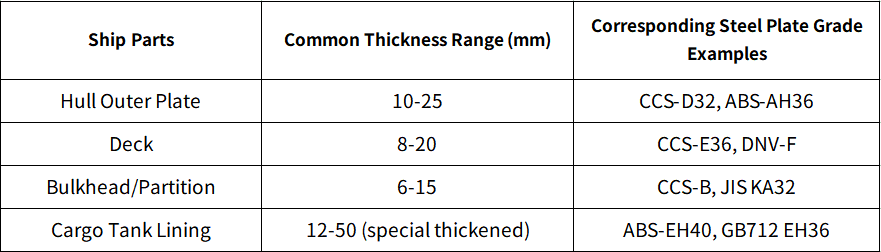
To meet specific requirements, shipbuilding steel plates are available in various grades and thicknesses. Common Grades include AH32, DH36, EH36, and FH40, among others, which are classified based on their minimum yield strength. These grades provide different levels of strength and toughness, depending on the intended use and classification society Regulations.
In terms of strength characteristics, hull steel is divided into ordinary strength steel (minimum yield strength of 235 MPa (24 kgf/mm²)) and three types of high-strength steel (yield strengths of 315 MPa (32), 355 MPa (36), and 390 MPa (40 kgf/mm²), respectively). This comprehensive strength range provides shipyards with flexible options for optimizing shipbuilding performance design and providing flexible ship structures.
Shipbuilding steel plates undergo rigorous testing and quality control measures to ensure their reliability and adherence to international standards. They are subject to various tests, including tensile testing, impact testing, and ultrasonic examination, to verify their mechanical properties and detect any defects or imperfections.

Technical Requirements for Shipbuilding Steel
1. Strength Requirements. Higher strength can reduce hull weight, reduce welding workload, and increase load-bearing capacity. The use of high-strength steel is constrained by hull rigidity and corrosion resistance.
2. The hull lines are complex, involving various types of single curves or hyperboloids, requiring multiple forming operations such as cold and hot bending and straightening. This necessitates the steel's adaptability to shipbuilding processes, including welding and repair.
3. The required plasticity and toughness are sufficient to compensate for the effects of work hardening and thermal cycling during construction. For critical areas such as the bow, areas of highest longitudinal bending stress, the bottom, and the hull's crack arrestor plates, high crack resistance is required, along with a low ductile-brittle transition temperature and sufficient impact absorption energy at low temperatures.
4. Resistance to seawater corrosion.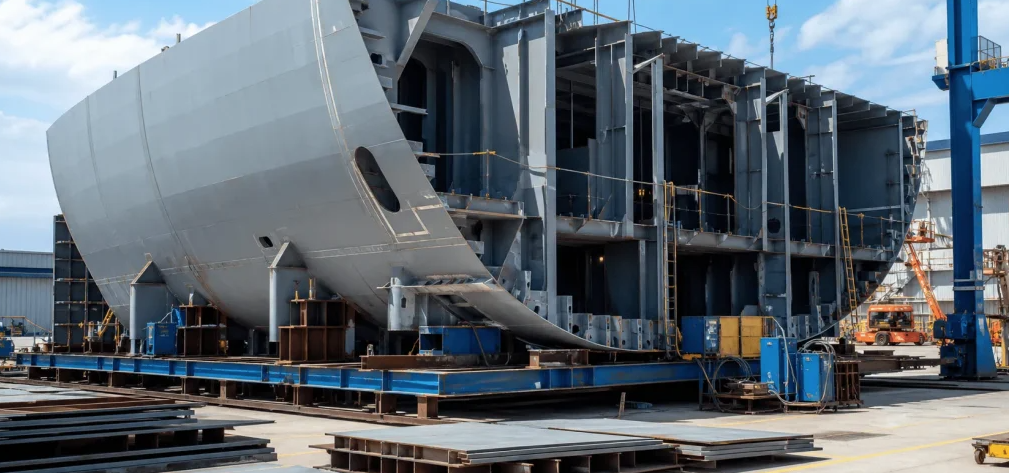
Application of shipbuilding steel plates:
The primary purpose of shipbuilding steel plates is to provide structural integrity and strength to the hull of a ship. They are used in the construction of various ship components, such as the hull, decks, bulkheads, and superstructures. These plates are engineered to withstand the harsh conditions of the marine environment, including exposure to seawater, extreme temperatures, and heavy loads.
In conclusion, shipbuilding steel plates are essential components in the construction of ships. and marine structures. With their high strength, excellent corrosion resistance, and tailored mechanical properties, these plates provide the necessary structural integrity to withstand the demanding conditions of the marine environment.
There are different standards in different countries. And according to the different uses of shipbuilding steel plates, there will be different specifications and standards for the shipbuilding steel plates. Here are some commonly used specification standards for shipbuilding steel plates in China, the United States, the United Kingdom, and Japan:
China Standard:
GB/T 712-2022: Structural steel for ship and ocean engineering
GB/T 5312-2009: Carbon and carbon-manganese steel seamless steel tubes and pipes for ship
American standard:
ASTM A131: Standard specification for structural steel plates for ships
ABS (American Bureau of Shipping) Rules: Classification society rules for shipbuilding steel plates
British Standards:
Lloyds Register of Shipping: Classification society rules for shipbuilding steel plates
BS 4360: Specification for weldable structural steels
BS 7191: Specification for higher-strength steel plates for shipbuilding
Japanese Standards:
JIS (Japanese Industrial Standards) G3106: Standard specification for hot-rolled steel plates, sheets, and strips for general structural usage
JIS G3136: Standard specification for hot-rolled steel plates for pressure vessels for intermediate and high-temperature service
JIS G3193: Standard specification for dimensions, mass, and permissible variations of hot-rolled steel plates, sheets, and strips
International and domestic standard systems for marine steel plates
Marine steel plates need to meet strict corrosion resistance, strength, and welding performance requirements, and their specifications and model standards are mainly divided into two categories:
International classification society standards
China CCS: divided into general strength grades A/B/D/E (such as CCS-A) and high strength grades AH32-DH40, with yield strengths ranging from 235MPa to 390MPa.
American ABS: The classification is similar to CCS, but with the addition of "EH" series (such as ABS-EH36), which is suitable for extremely cold environments.
European DNV: Emphasis on low-temperature toughness; DNV-A to F levels correspond to different temperature thresholds (-60°C to 0°C).
National standards
China's "GB/T 712-2011 Structural Steel for Ships and Marine Engineering" clarifies the chemical composition and mechanical properties (such as sulfur content ≤ 0.035%).
In the Japanese JIS G 3106 standard, KA36 is equivalent to ASTM A131.
Copyright Notice © 2022 - 2023 ChinaSteelMarket.com All rights reserved.