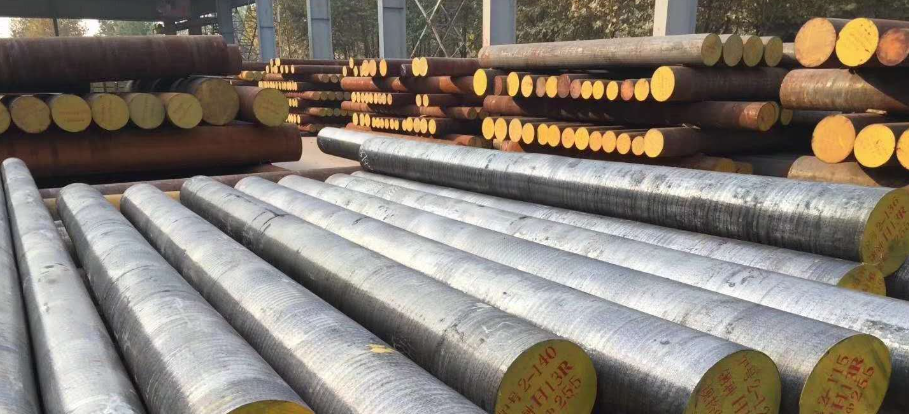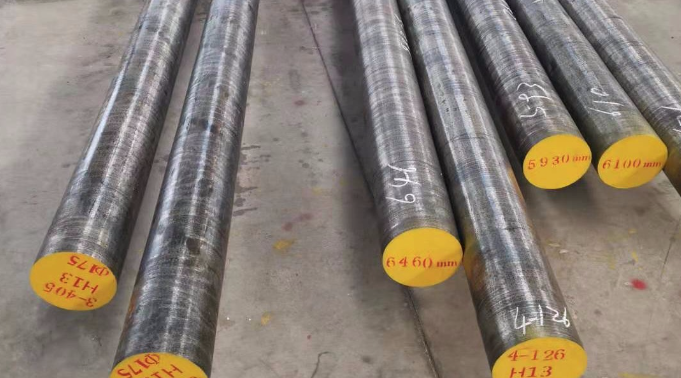

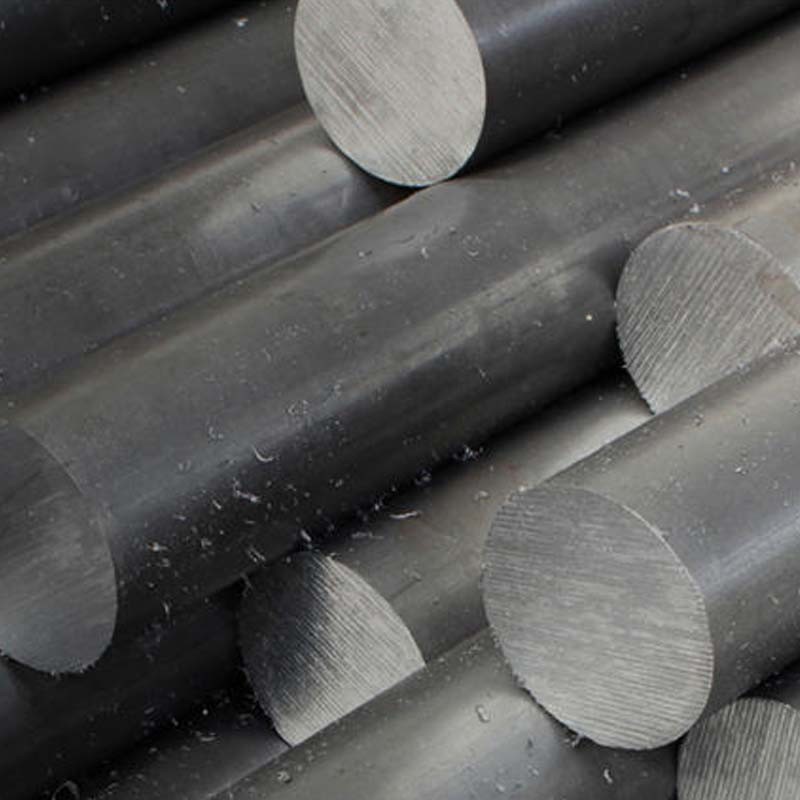
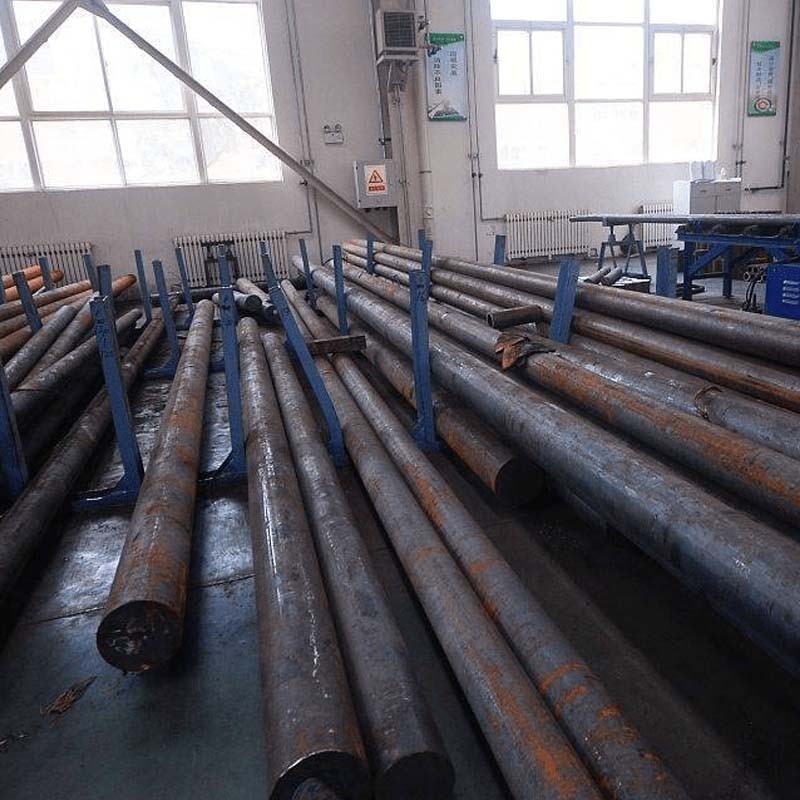
Hot-work die steel round bars are specialized alloy tool steel products used to manufacture molds for the hot deformation of metals under high temperature and high pressure (such as hot forging dies and die-casting molds). Their core value lies in their excellent high-temperature strength (red hardness), toughness, and resistance to thermal fatigue, enabling them to withstand cyclic conditions of rapid heating and cooling.
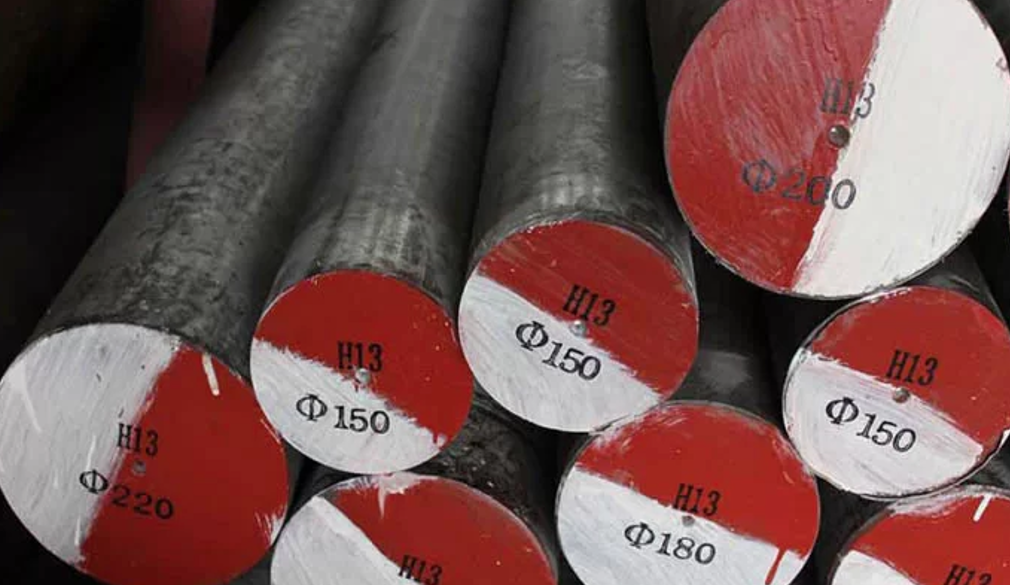
Hot-work die steels typically have a carbon content of 0.3% to 0.6% and incorporate alloying elements such as Cr, W, Mo, and V to enhance hardenability, high-temperature hardness, and oxidation resistance.
Based on application, they are primarily categorized into:
1. Steels for hot forging dies: Subjected to massive impact loads; require high toughness and strength.
2. Steels for die-casting molds: In contact with molten metal; require resistance to thermal fatigue and molten metal erosion.
3. Steels for hot extrusion dies: Require high-temperature strength and wear resistance.
4. Steels for hot upsetting dies.
Based on heat resistance, they can be classified into low-heat-resistance steels (operating temperature 350–370°C) and medium-heat-resistance steels, among others. Based on alloying element content, they are classified as low-, medium-, or high-alloy steels.
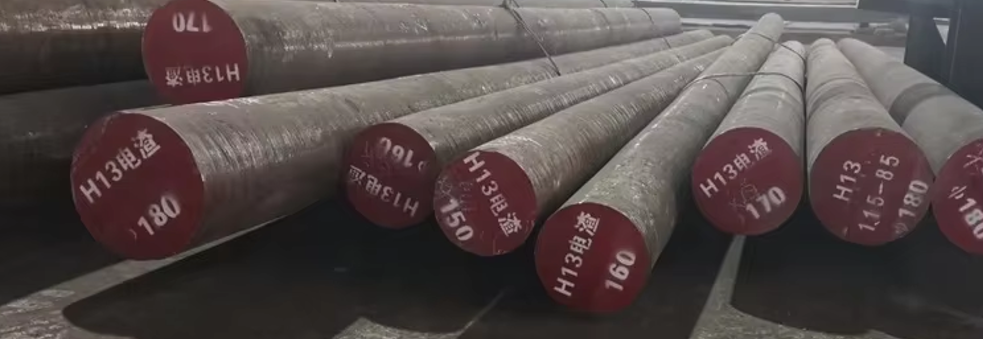
The production of hot-work die steel round bars centers on a process of "high-purity smelting + forging + heat treatment." The typical process route is:
Electric furnace smelting → LF refining → VD/VOD vacuum degassing → Electroslag Remelting (ESR) → High-temperature diffusion annealing → Multi-directional forging → Preliminary heat treatment (spheroidizing annealing) → Final heat treatment.
1. Smelting: Employs a duplex process—either Electroslag Remelting (ESR) alone or Vacuum Induction Melting (VIM) combined with ESR—to minimize oxygen, sulfur, and inclusion content, thereby enhancing purity and isotropy.
2. Forging: Multi-directional forging (with an upsetting ratio ≥ 1.8) is used to break up the as-cast carbide network; the final forging temperature is typically controlled between 850°C and 900°C, and the total forging ratio can reach 7 to 8. 3. Heat Treatment: After forging, high-temperature diffusion annealing (e.g., holding at 1050°C for 6 hours) is required to eliminate segregation, followed by spheroidizing annealing to obtain a uniform granular pearlite microstructure, which facilitates machining. The final heat treatment typically consists of quenching (1040–1060°C) followed by double or triple tempering (540–600°C) to achieve a microstructure of tempered martensite and carbides, thereby optimizing the balance between strength and toughness.
The main grades and characteristics of commonly used domestic hot-work die steel round bars are as follows:
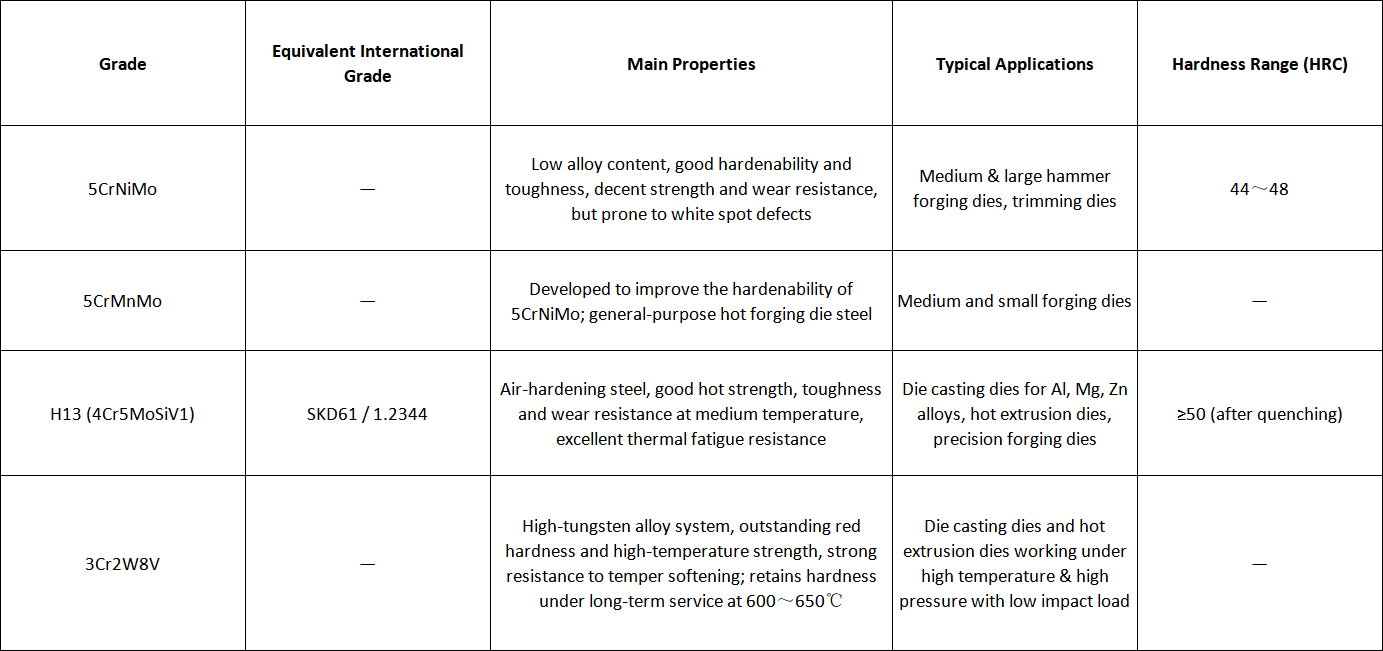
Hot-work dies are subjected to significant impact forces during operation; they come into contact with high-temperature metal and undergo repeated heating and cooling, resulting in extremely harsh service conditions. To meet these operational requirements, hot-work die steels must possess the following basic characteristics:
1. High elevated-temperature strength and good toughness. Hot-work dies—particularly hot forging dies—endure substantial impact forces at high frequencies during operation. Insufficient strength or toughness makes them prone to cracking.
2. Good wear resistance. During workpiece deformation, hot-work dies are subjected not only to frictional wear but also to high-temperature oxidation, corrosion, and abrasion from metal scale; therefore, the steel requires high hardness and resistance to adhesion (galling).
3. High thermal stability. Thermal stability refers to the steel's ability to retain its room-temperature mechanical properties during prolonged exposure to high temperatures. During operation, hot-work dies contact high-temperature or even molten metal, resulting in high surface temperatures—typically between 400°C and 700°C. Consequently, the steel must resist thermal softening and maintain high thermal stability; otherwise, plastic deformation may occur, leading to structural collapse or failure.
4. Excellent thermal fatigue resistance. Hot-work dies operate under conditions of repeated heating and cooling. The die expands upon heating and contracts upon cooling, generating significant, alternating thermal stresses. Under the influence of these cyclic thermal stresses, a network of cracks (heat checking) forms on the die surface; this phenomenon is known as thermal fatigue. Premature die fracture caused by thermal fatigue is a primary failure mode for hot-work dies; therefore, hot-work die steels must exhibit excellent resistance to thermal fatigue.
5. High hardenability. Hot-work dies—particularly those used for hot forging—are often large in size. To ensure uniform mechanical properties across the entire cross-section of the die, the steel requires high hardenability.
6. Good thermal conductivity. To prevent excessive heat accumulation that could degrade mechanical properties, it is necessary to minimize the die's surface temperature and reduce internal temperature gradients. This necessitates good thermal conductivity in the steel.
7. Good formability and machinability to meet manufacturing requirements.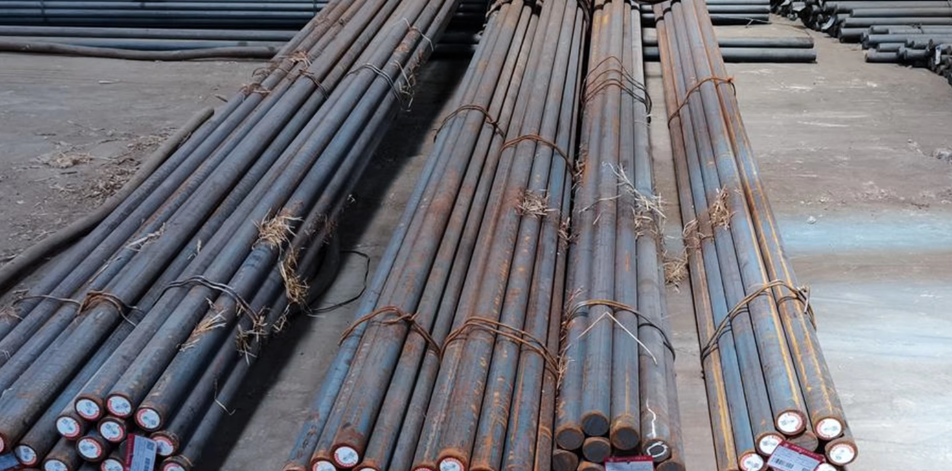
The application of hot-work die steel round bars is highly concentrated in three major sectors: non-ferrous metal die casting, hot forging, and hot extrusion:
1. Die-casting dies: High-pressure die-casting molds for automotive engine blocks, transmission housings, and structural components (e.g., H13, DIEVAR); large-scale integrated die-casting molds for telecommunications base stations, new energy vehicle battery trays, etc.
2. Hot forging dies: Large-scale hot forging molds for automotive steering knuckles, crankshafts, etc. (e.g., 5CrNiMo, ASH8-S).
3. Hot extrusion dies: Molds for extruding aluminum profiles and copper alloys (e.g., 3Cr2W8V, H13).
4. Hot stamping dies: Molds for the hot stamping of high-strength automotive crash-resistant components (e.g., ASH7).
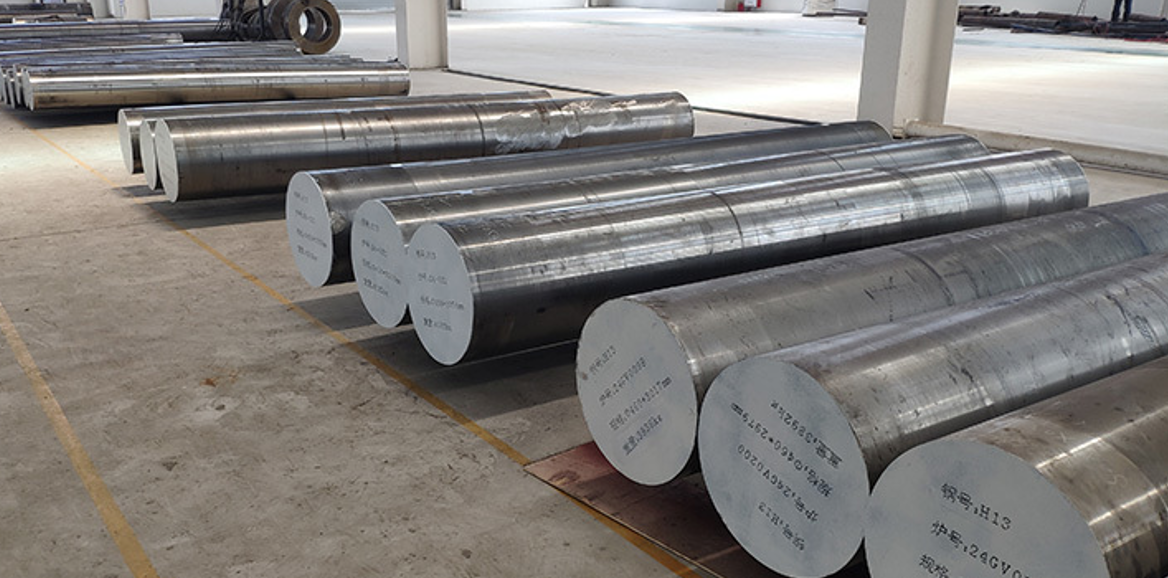
Hot-work die steel round bars are specialized alloy tool steel products used to manufacture die-casting, hot forging, and hot extrusion molds, with key grades including H13 (4Cr5MoSiV1), 5CrNiMo, and 3Cr2W8V. Currently, integrated die casting for new energy vehicles is the primary driver of technological upgrades in the industry, making high-thermal-conductivity, ultra-large, and long-service-life hot-work die steels the focal point of future competition.




|

|

|

|

|
| Timely Info | Independent | Platform | Multiple guarantees | Self-operated storage |
China Steel Market
Empowering small and medium-scale steel purchasing

| About us | Channel | Useful tools |
|---|---|---|
| About China Steel Market | Prices | Steel Weight Calculation |
| Contact Us | Answers | Why Choose Us |
| Terms & Conditions | Inventory | |
| Privacy Policy | Help |
Hot search words:
China Rebar prices China Wire Rod Prices Welded Steel Pipe Prices