
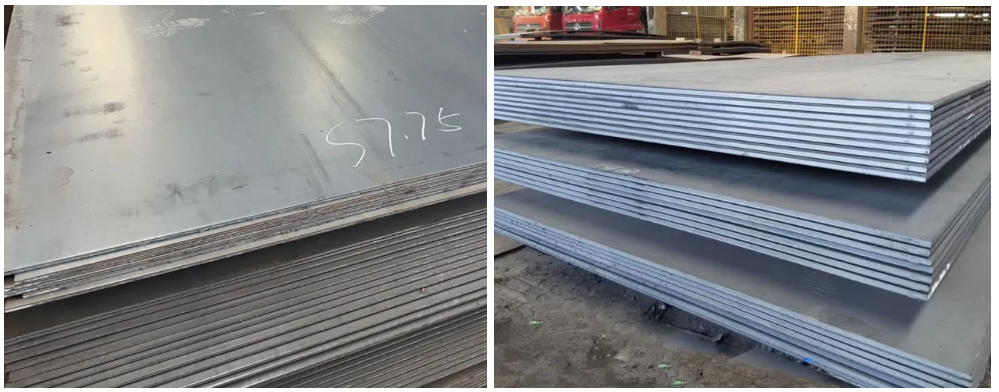
Hot rolled steel plate can be understood as a steel product transformed from a "coil" into a "plate." Although called a "plate," it is not directly rolled by the steel mill, but rather "slit" from a hot-rolled steel coil (like a huge steel strip) through subsequent processing; it is a typical "secondary processing" product.
Production Process: Hot rolled steel plate use continuously cast slabs or pre-rolled slabs as raw materials. These are heated in a walking beam furnace, descaled with high-pressure water, and then enter the roughing mill. The rough-rolled material is then trimmed at the head and tail before entering the finishing mill, where computer-controlled rolling is implemented. After final rolling, it undergoes laminar flow cooling (computer-controlled cooling rate) and is coiled by a coiler to become a straight coil. The head and tail of the straight coil are often tongue-shaped or fishtail-shaped, with poor thickness and width accuracy, and the edges often have defects such as waviness, folds, and tapering. The coil is relatively heavy, and the inner diameter of the steel coil is 760mm.
The core process is: Steel coil → Uncoiling → Leveling (multi-roll straightening) → Cutting to length → Finished sheet metal.
In this process, the steel coil is unrolled, flattened by a multi-roll straightener, and then cut into sheets according to the length required by the user.
Hot rolled steel plate metal technical parameters:
Process parameters of sheet metal and medium plate:
Sheet metal has a higher internal stress level, resulting in poorer dimensional stability. The distribution of internal stress varies depending on the process parameters during leveling, leading to differences in load-bearing capacity in different directions along the vertical length. This load-bearing capacity is difficult to measure using general strength indicators.
Therefore, sheet metal will experience significant welding deformation during welding, which is difficult to adjust. Thus, sheet metal cannot be used for components with high appearance quality requirements.
Performance characteristics of Hot rolled steel plate metal: Advantages and limitations
Hot rolled steel plate metal has very distinct characteristics, with both advantages and limitations.
Advantages:
Low price: Low production cost, typically 10%-20% cheaper than the original sheet metal of the same specifications. For specific pricing, please click on Price.
Flexible Dimensions: Lengths can be customized to meet specific needs, effectively reducing waste and saving materials.
Convenient Transportation: Can be cut to standard lengths for easy transport and handling.
Limitations: High Internal Stress, Instable Dimensions: The "leveling" process from coil to sheet introduces significant internal stress, leading to poor dimensional stability and a tendency for warping, especially with thicker sheets.
Prone to Welding Deformation: Internal stress is released during welding, resulting in significant welding deformation that is difficult to adjust.
Surface and Precision: Surface quality and dimensional accuracy (especially thickness) are generally inferior to the original flat sheet.
Dimensions and Specifications:
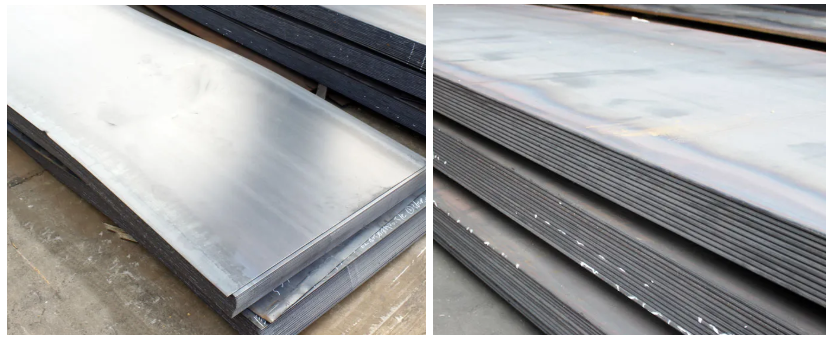
Hot-rolled steel sheets are available in a variety of sizes and thicknesses to meet diverse application requirements. Common thicknesses range from a few millimeters to several centimeters. Standard steel sheet dimensions typically range from 1200 mm to 2500 mm in width and 2400 mm to 12000 mm in length.
Applications:
Hot-rolled steel sheets are widely used in various industries and fields. They are commonly used in construction, heavy machinery manufacturing, shipbuilding, piping, and other general structural applications requiring high strength and durability.
Grades and Standards: Hot-rolled steel sheets are available in various grades and specifications to meet specific mechanical and chemical performance requirements. Different international standards such as ASTM, EN, JIS, and DIN provide guidance for the composition and mechanical properties of hot-rolled steel sheets.
Subsequent Processing:
After hot rolling, the steel sheet may require subsequent processing such as cutting, bending, and surface treatment to meet the specific requirements of the intended application.
It is worth noting that hot-rolled steel sheets may have some disadvantages, such as dimensional tolerances and surface defects that may occur during the rolling process. In some cases, cold-rolled steel sheets or further processing may be necessary to achieve tighter dimensional tolerances and a smoother surface.
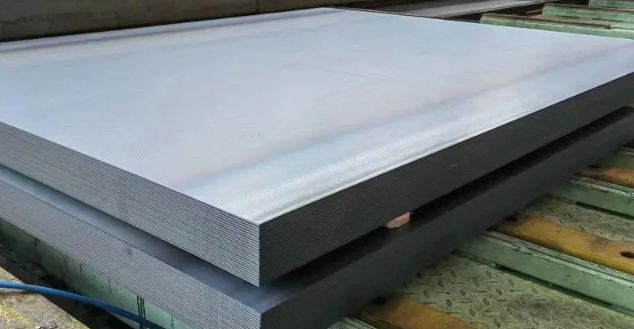
Hot rolled steel plate are an economical and flexible steel product that meets diverse dimensional requirements by "flattening" hot-rolled steel coils. Its core advantages are low price and customizable dimensions, but the trade-off is higher internal stress and susceptibility to welding deformation. Therefore, when making a selection, the advantages and disadvantages should be weighed according to the specific purpose: for non-critical structures and scenarios where cost-effectiveness is the priority, open-plate is a good choice; while for critical parts that bear loads, are pressure-bearing, and have strict requirements for welding deformation, the original plate with more stable performance should be given priority.
In China, hot-rolled steel plates are manufactured and supplied according to standards set by the Chinese National Standards or industry-specific standards. The most commonly used standard for hot-rolled steel plates in China is the GB/T 3274 standard, which covers a wide range of hot-rolled plates used in various structural applications.
Some of the key GB/T standards for hot-rolled steel plates in China include:
GB/T 3274-2017: This standard specifies hot-rolled plates and strips for carbon structural steels and high-strength low-alloy structural steels. It covers a wide range of grades and dimensions used in general structural applications.
GB/T 1591-2018: This standard specifies high-strength low-alloy structural steels. It includes several grades with different minimum yield strengths suitable for various structural applications.
GB/T 3273-2015: This standard specifies hot-rolled plates and strips for cold forming.
In the United States, the most commonly used standard for hot-rolled steel plates is the ASTM A36 standard. ASTM A36 is a widely accepted standard for carbon structural steel and covers a range of hot-rolled steel plates used in general structural applications.
ASTM A36 steel plates are available in various shapes, including plates, bars, and shapes. It sets minimum mechanical properties and chemical composition requirements for carbon steel plates used in structural applications. Some of the key mechanical properties specified by ASTM A36 include:
Other than ASTM A36, there are other ASTM standards for specific applications or higher-strength steel plates, such as ASTM A572 for high-strength, low-alloy (HSLA) steel plates, ASTM A514 for high-yield-strength, quenched, and tempered alloy steel plates, and ASTM A516 for pressure vessel plates.
In addition to ASTM standards, other organizations like ASME (American Society of Mechanical Engineers) also have standards for hot-rolled steel plates used in specific applications.
In the United Kingdom, hot-rolled steel plates are commonly manufactured and supplied according to European standards, known as EN (European Norm) standards. These standards are developed and maintained by the European Committee for Standardization (CEN) and are adopted by member countries of the European Union, including the UK.
Some of the key EN standards for hot-rolled steel plates in the UK include:
EN 10025-2: This standard specifies technical delivery conditions for non-alloy structural steels. It covers a wide range of hot-rolled plates used in general structural applications. The grades commonly used within this standard include S235, S275, S355, and others, each with different minimum yield strengths.
EN 10025-6: This standard covers high-yield-strength, quenched, and tempered structural steel plates. It includes several grades with enhanced mechanical properties, suitable for use in demanding structural applications.
EN 10028-2: This standard specifies requirements for flat products made of pressure vessel steels. It covers hot-rolled plates used in the fabrication of pressure vessels for elevated-temperature applications.
EN 10029: This standard specifies tolerances on dimensions, shape, and mass for hot-rolled steel plates with a thickness greater than or equal to 3mm.
EN 10111: This standard specifies the general requirements for hot-rolled low-carbon steel sheet and strip.
EN 10149-2: This standard specifies hot-rolled flat products made of high-yield-strength steels for cold forming. It includes several grades suitable for cold forming processes.
EN 10163: This standard specifies the delivery requirements for surface condition of hot-rolled plates and wide flats.
In Japan, hot-rolled steel plates are manufactured and supplied according to the standards set by the Japanese Industrial Standards (JIS). JIS is a national standardization body in Japan responsible for developing and maintaining standards across various industries, including the steel industry.
Some of the key JIS standards for hot-rolled steel plates in Japan include:
JIS G 3101: This standard specifies hot-rolled general structural steel plates, shapes, and sections. It covers a wide range of hot-rolled steel products used in general structural applications.
JIS G 3113: This standard specifies hot-rolled steel plates, sheets, and strips for automobile structural uses. It includes several grades suitable for automotive applications, providing specific mechanical and formability properties.
JIS G 3131: This standard specifies hot-rolled mild steel plates, sheets, and strips. It covers low-carbon steel grades suitable for general applications, such as forming and welding.
JIS G 3132: This standard specifies hot-rolled carbon steel strip for pipes and tubes. It includes several grades with specific mechanical properties for pipe and tube manufacturing.
JIS G 3134: This standard specifies hot-rolled high-strength steel plates with improved formability for automotive applications.
JIS G 4051: This standard specifies carbon steels for machine structural use, including hot-rolled steel plates.
JIS G 4053: This standard specifies low-alloyed steels for machine structural use, including hot-rolled steel plates.
Copyright Notice © 2022 - 2023 ChinaSteelMarket.com All rights reserved.