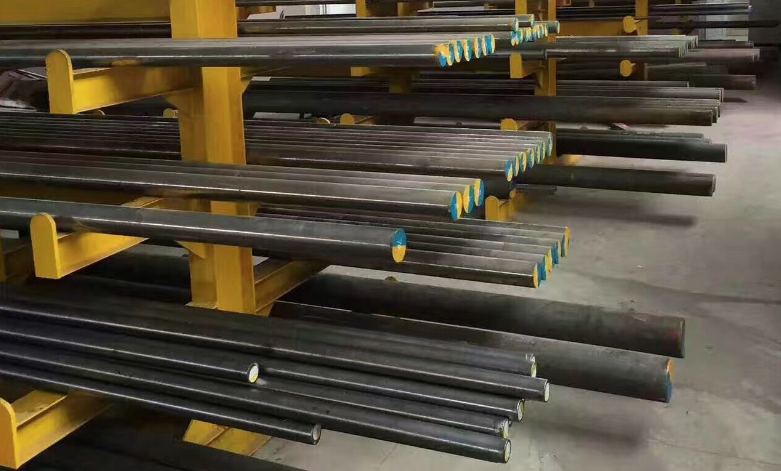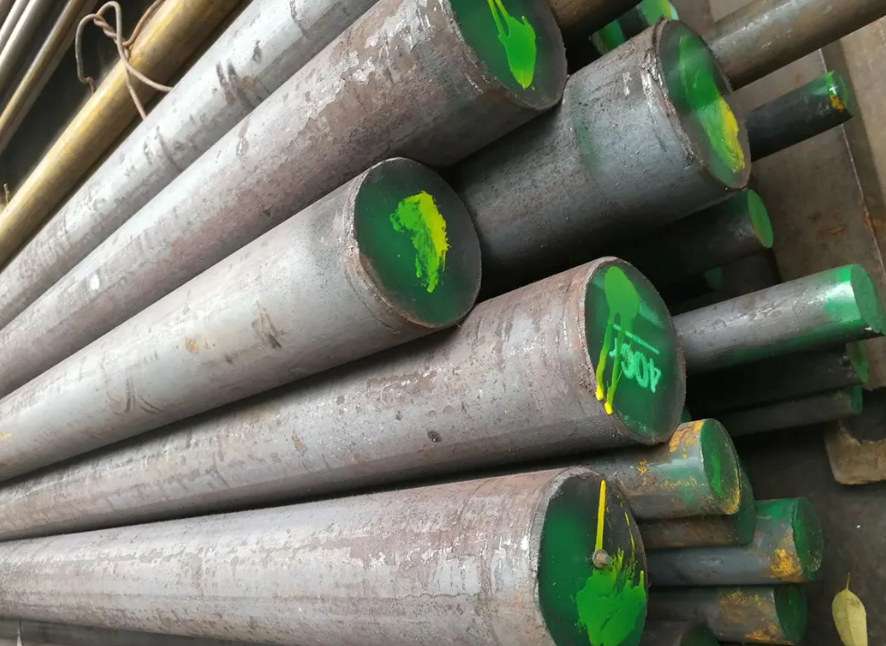

Cold-work die steels are used for molds and tools involved in forming processes—such as stamping, shearing, cold extrusion, deep drawing, and cold heading—performed at room or relatively low temperatures. Their core requirements include maintaining high hardness, superior wear resistance, and adequate toughness under conditions of high contact stress and repetitive impact and friction. They must also exhibit good hardenability, dimensional stability during heat treatment, and resistance to chipping or cracking. Typically containing high levels of carbon and alloying elements such as chromium, molybdenum, and vanadium, these steels derive their wear resistance from the formation of stable, fine carbides and achieve a balance of strength and toughness in their martensitic matrix through heat treatment. They are widely used for blanking dies, forming dies, cold extrusion dies, thread-rolling dies, and various punches and female dies.
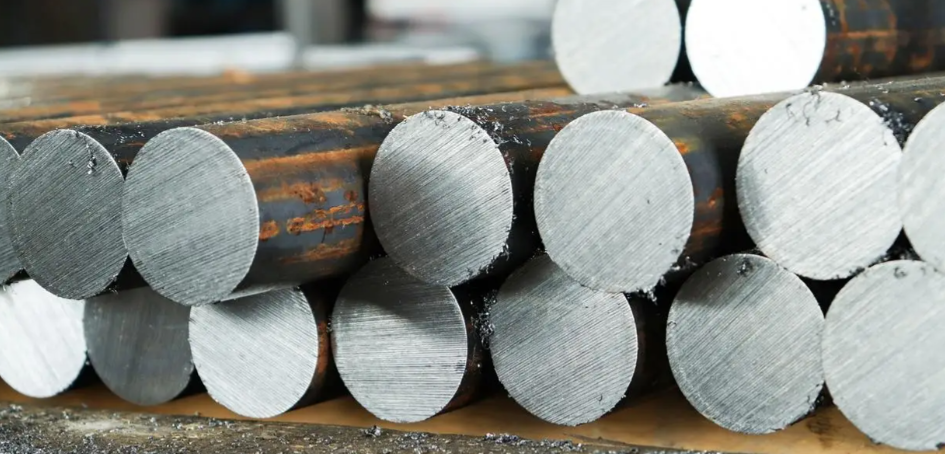
These steels generally feature high carbon and chromium content (e.g., Cr12MoV contains 1.45–1.70% carbon and 11.00–12.50% chromium) and can achieve a high hardness of HRC 58–62 after appropriate heat treatment. Their wear resistance and compressive strength far exceed those of ordinary steels, enabling them to withstand the high-load impacts and repetitive wear associated with cold-working processes.
Key Grades and Properties
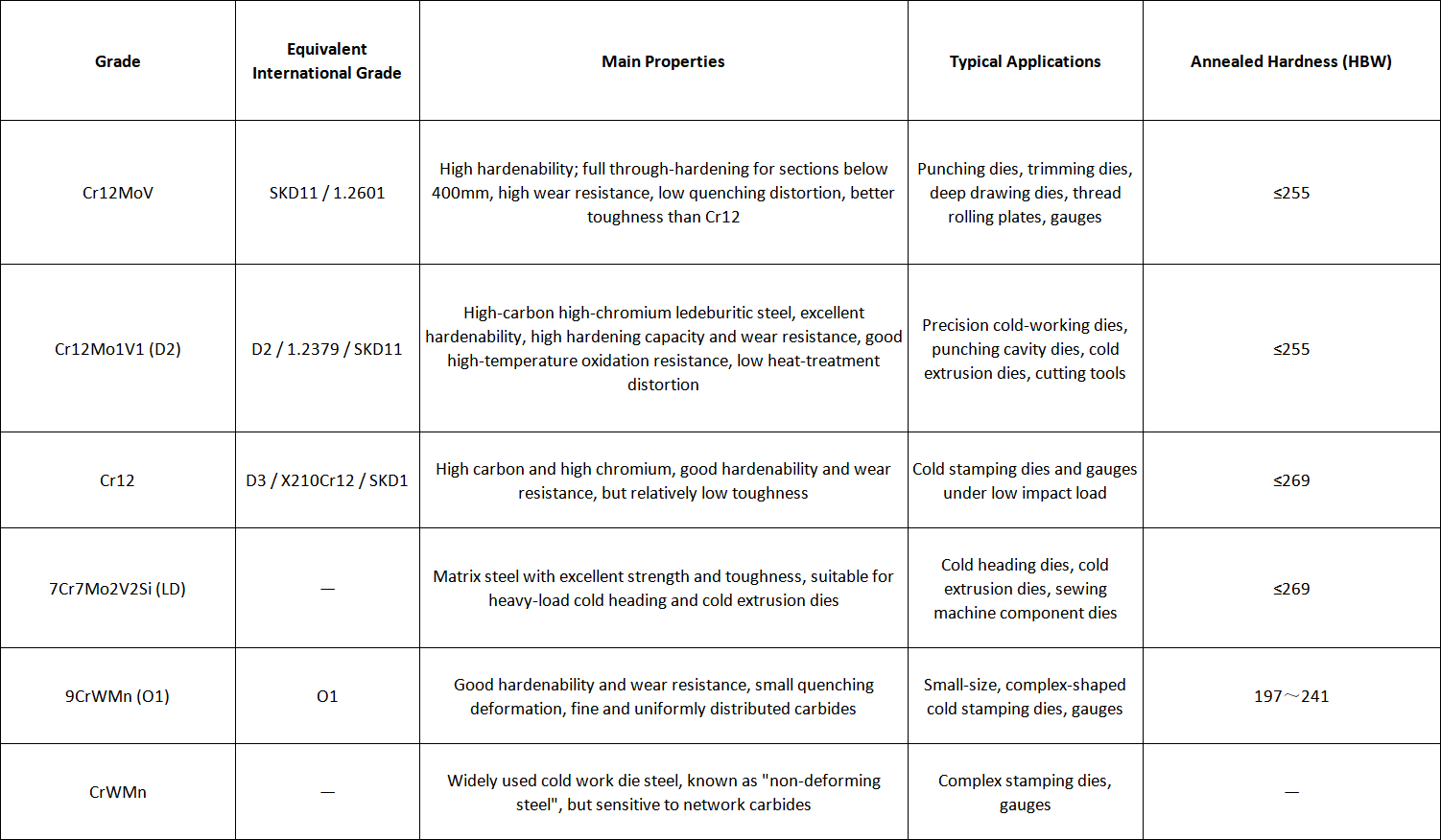
Cr12MoV can reach a hardness of ≥60 HRC after heat treatment; D2 steel can reach 60 HRC after heat treatment.
Cold-work die steels and hot-work die steels are two common types of die steel materials; they differ in terms of composition, processing techniques, and performance characteristics. Primarily, cold-work die steels are designed for cold-working processes and are characterized by high hardness, excellent wear resistance, and high dimensional stability.
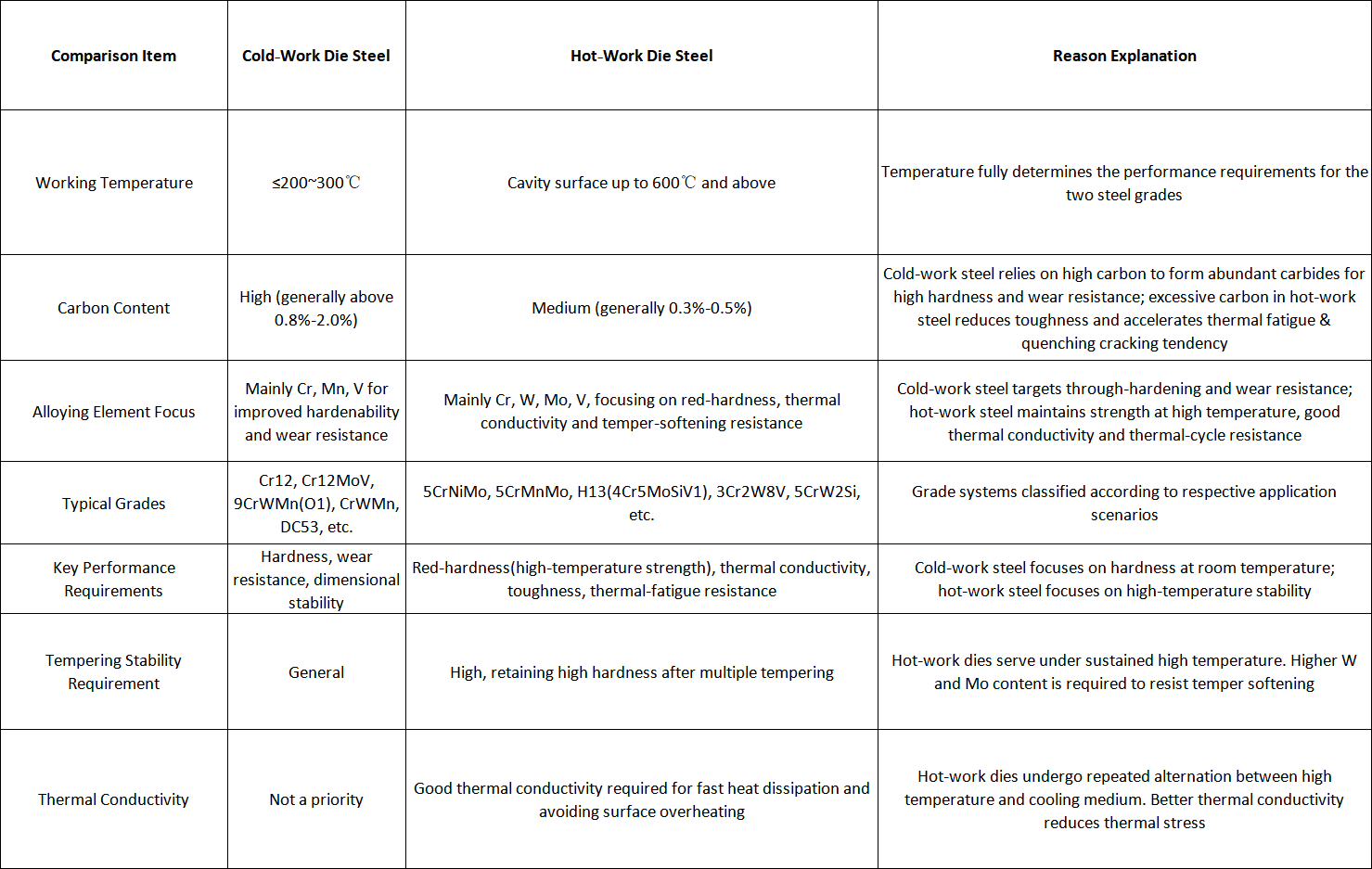
1. Difference in carbon content: Cold-work die steels have high carbon content to facilitate the formation of abundant carbides, thereby directly achieving high hardness and wear resistance (e.g., Cr12-type steels contain up to approximately 2% carbon). Conversely, hot-work die steels require lower carbon content (typically 0.3%–0.5%); while higher carbon increases hardness, it compromises toughness. Since hot forging and hot extrusion operations subject dies to impact loads and rapid thermal cycling, insufficient toughness would lead to cracking.
2. Difference in alloying elements:
Cold-work steels incorporate Cr, Mn, and V: These are primarily used to enhance hardenability (ensuring through-hardening even in large cross-sections) and increase carbide content (improving wear resistance).
Hot-work steels incorporate Cr, W, Mo, and V: W and Mo are critical, as they form stable high-temperature carbides that impart red hardness (maintaining hardness at temperatures above 600°C) and significantly improve resistance to tempering softening. V refines grain size to enhance toughness, while Cr improves hardenability and oxidation resistance.
3. The fundamental reason: Operating temperature. Cold-worked steels are rarely exposed to high temperatures, so the priority is simply "hardness and wear resistance." In contrast, the cavity surfaces of hot-work steels can reach temperatures exceeding 600°C and are subjected to repeated heating and cooling (thermal fatigue) as well as impact loads.
Therefore, while maintaining adequate hardness, these steels must specifically address four key properties: red hardness, thermal conductivity, resistance to tempering softening, and resistance to thermal fatigue. All four properties are achieved through alloying composition, which directly accounts for the differences in their respective alloy systems.
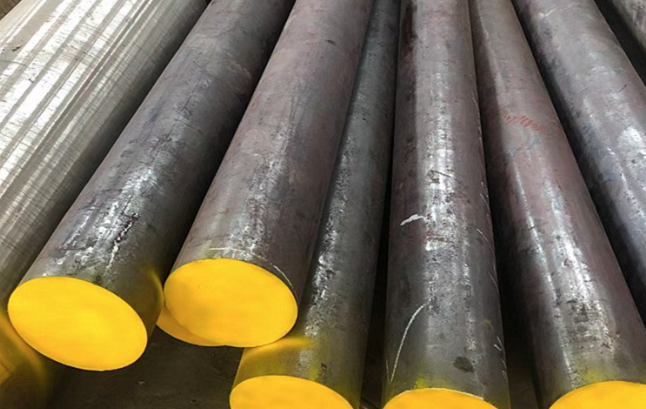
1. High Hardness and Wear Resistance: Cold-work die steels possess high hardness, allowing them to withstand significant pressure and friction during cold-working processes without easily deforming or sustaining damage. Their material composition and hardness ensure superior wear resistance, enabling long-term service without failure.
2. Excellent fatigue resistance: Cold-work die steels can withstand immense stress during prolonged cold-working processes; they are resistant to fracture or cracking and exhibit superior fatigue resistance. This makes them highly suitable for high-frequency cold-working operations and helps enhance production efficiency.
3. Good corrosion resistance: As cold-work die steels frequently come into contact with various chemical substances and solutions during processing, they possess good corrosion resistance. This characteristic ensures a long service life and maintains stable performance even in harsh working environments.
4. Machinability: The hardness and strength of cold-work die steels can be modified through heat treatment to meet specific processing requirements. Additionally, these steels are suitable for applications such as cutting, shearing, and precision die machining.
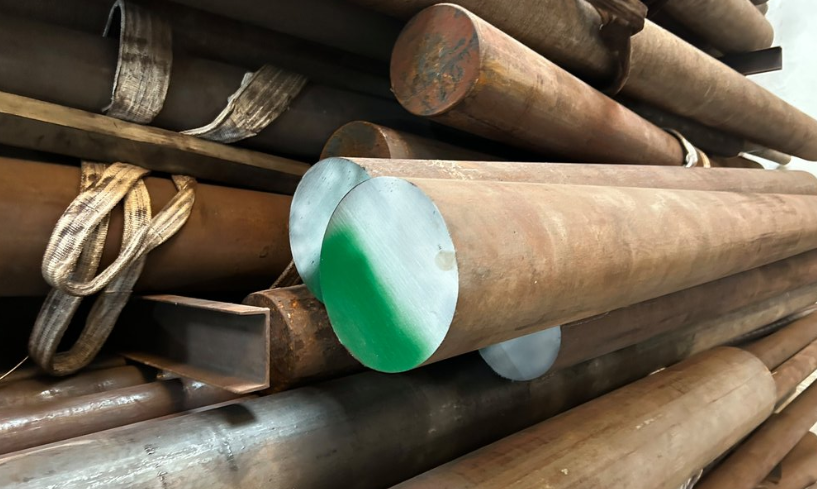
1. Stamping dies: Dies for automotive body panels, home appliance sheet metal, and precision 3C electronics components.
2. Cold heading/cold extrusion dies: Dies for fasteners, bolt forming, and stainless steel fasteners.
3. Shearing dies: Cold-cutting shears, trimming dies, and blanking dies.
4. Measuring tools and cutting tools: Gauges, thread rolling dies, thread rolling plates, and wire drawing dies.
5. Precision dies: Dies for connectors, lead frames, and precision progressive stamping.
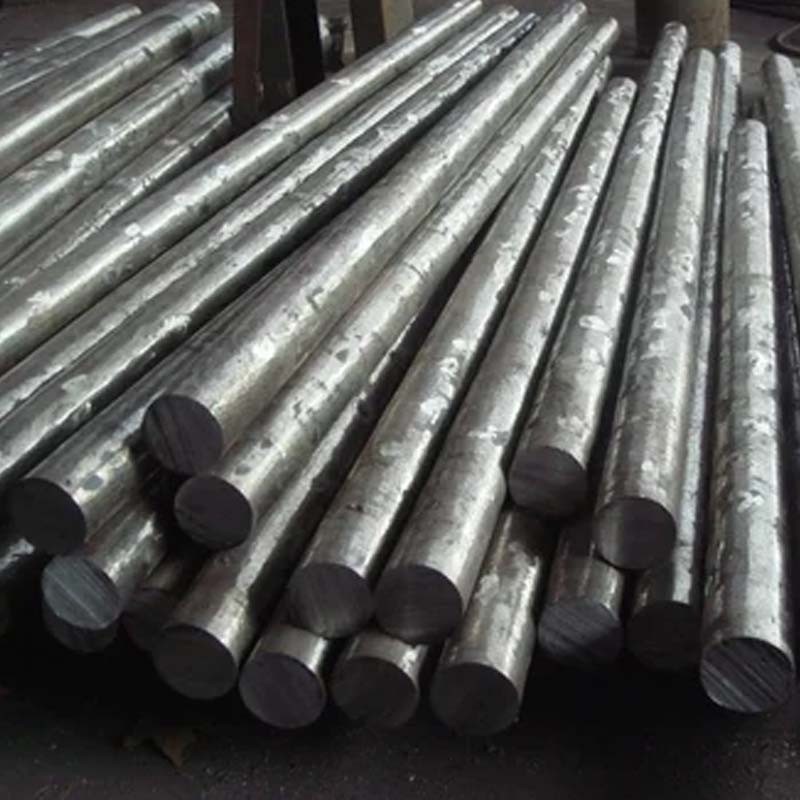
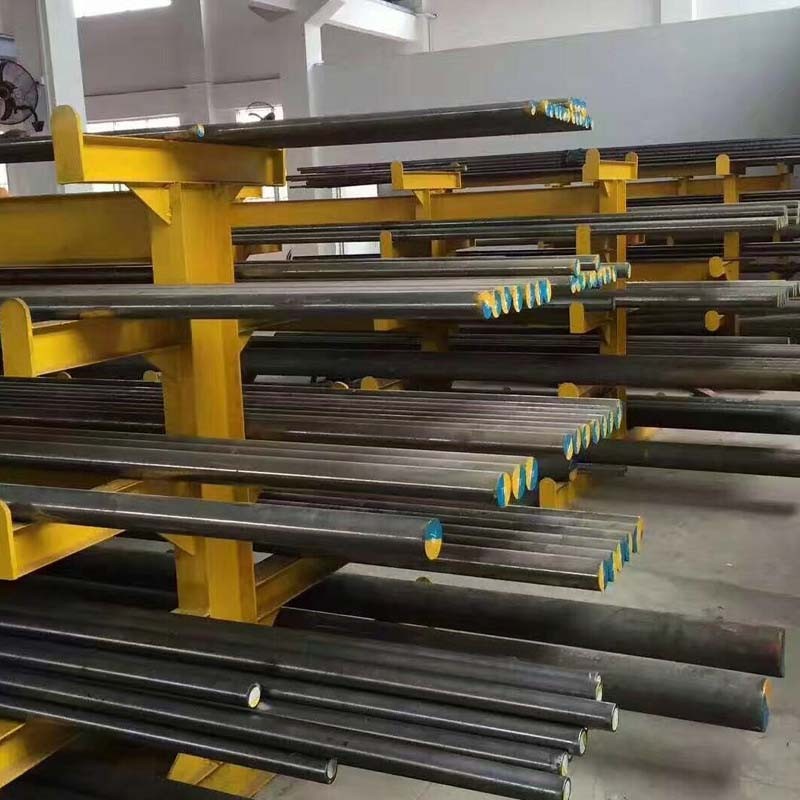
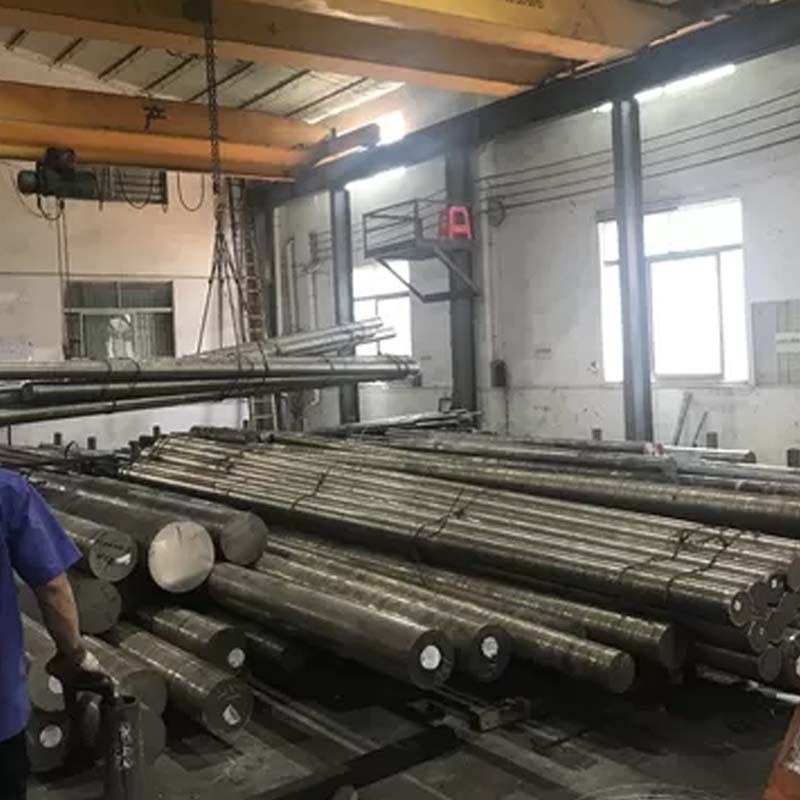
Cold-work die steel round bars are specialized alloy tool steel products used to manufacture stamping, cold heading, and shearing dies. Key grades include Cr12MoV, Cr12Mo1V1 (D2), CrWMn, and 7Cr7Mo2V2Si (LD), all manufactured in accordance with the GB/T 34564.1-2017 standard. Their performance relies on achieving a balance between high hardness, high wear resistance, and sufficient toughness.



|

|

|

|

|
| Timely Info | Independent | Platform | Multiple guarantees | Self-operated storage |
China Steel Market
Empowering small and medium-scale steel purchasing

| About us | Channel | Useful tools |
|---|---|---|
| About China Steel Market | Prices | Steel Weight Calculation |
| Contact Us | Answers | Why Choose Us |
| Terms & Conditions | Inventory | |
| Privacy Policy | Help |
Hot search words:
China Rebar prices China Wire Rod Prices Welded Steel Pipe Prices