
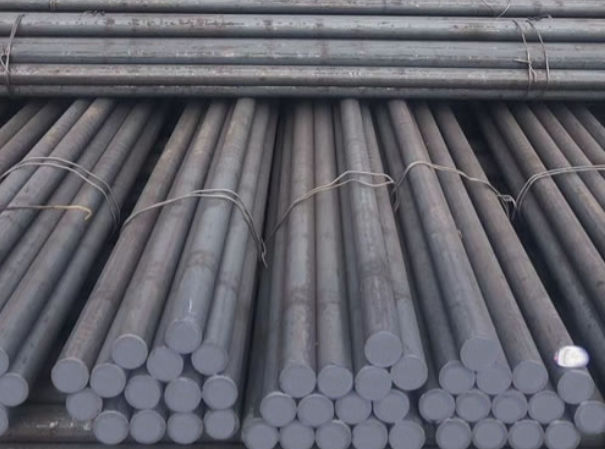
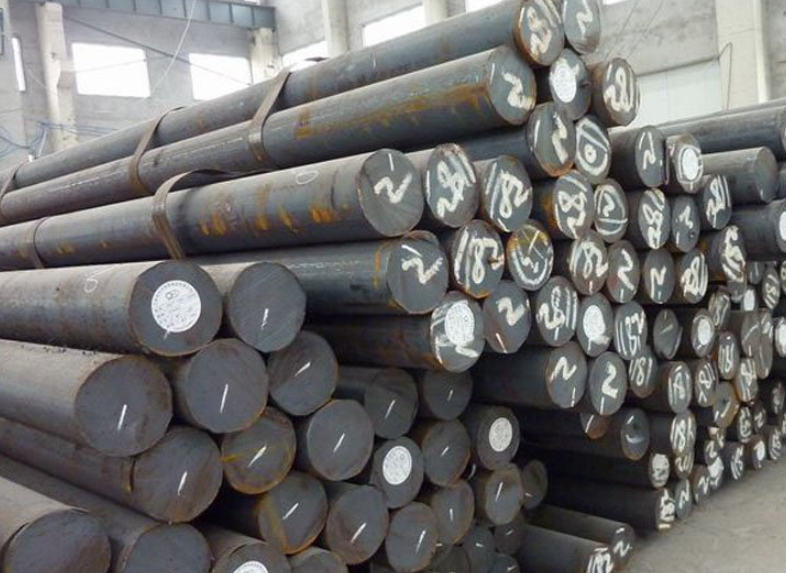
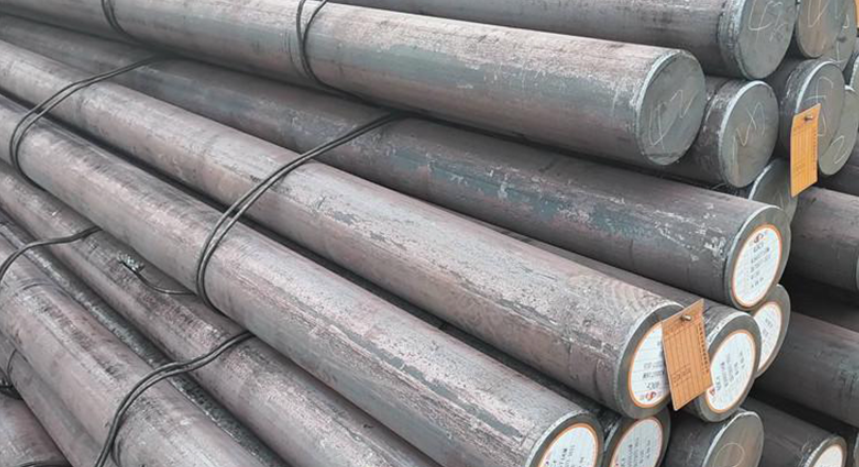
Carbon structural steel round bars are solid, long steel bars with a circular cross-section. They consist primarily of iron and carbon, with a carbon content ranging from 0.05% to 0.70%, and contain small amounts of elements such as silicon, manganese, phosphorus, and sulfur; no other alloying elements are intentionally added. Due to their low cost, wide range of properties, and high volume of use, they are widely applied in construction, machinery, bridges, and shipbuilding.
According to national standards and industry conventions, the classification criteria are as follows:
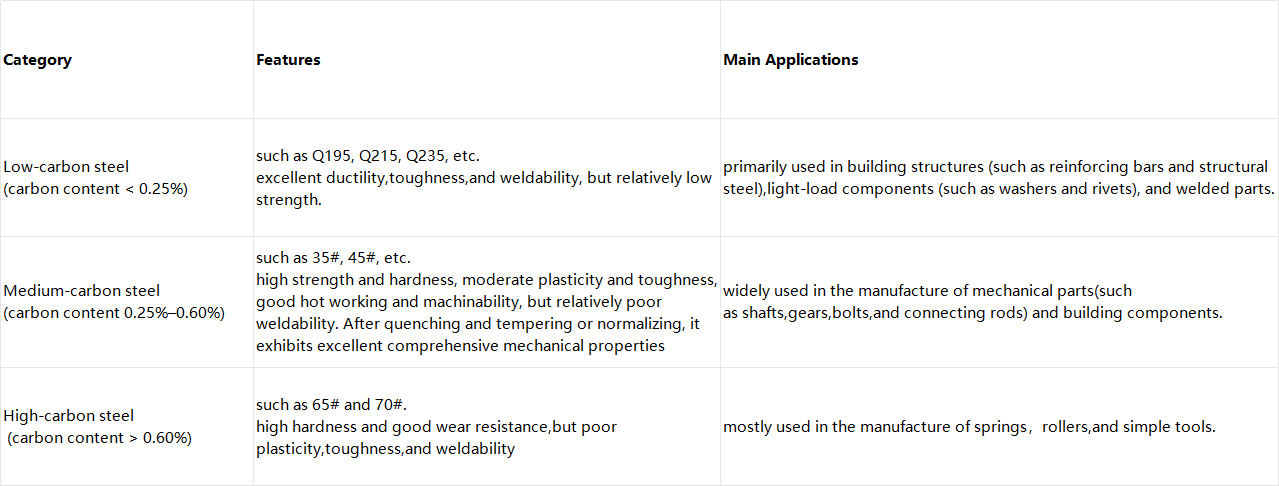
1. Classification by Carbon Content (Core Classification)
2. Classification by Steel Grade
Mild carbon structural steel: This steel has relatively broad tolerances for carbon content, performance ranges, and impurity limits (e.g., Q235). It contains a higher amount of impurities and is relatively inexpensive. Its carbon content is generally below 0.30%, and its manganese content does not exceed 0.80%. While it has lower strength, it offers good plasticity, toughness, and cold formability. Except in a few cases, it is generally not heat-treated and is used as-is. It is often fabricated into bar stock, shaped steel, and steel plates. It has many applications and is used in large quantities for applications with modest performance requirements. Currently, it is primarily used in railways, bridges, and various construction projects, as well as for manufacturing metal components subjected to static loads, non-critical mechanical parts that do not require heat treatment, and general welded components. At present, most bridges are constructed using ordinary carbon structural steel.
High-quality carbon structural steel: Compared to ordinary carbon structural steel, high-quality carbon structural steel has lower levels of sulfur, phosphorus, and other non-metallic inclusions. It offers superior performance and is often used for mechanical parts that require high strength and wear resistance. Based on carbon content and intended use, this type of steel is broadly divided into three categories:
① Steel with less than 0.25% carbon is classified as low-carbon steel. Among these, grades such as 08F and 08Al—which contain less than 0.10% carbon—are widely used for deep-drawn parts in industries such as automotive and can manufacturing due to their excellent deep-drawing and weldability. Grade 20G is the primary material used in the manufacture of general-purpose boilers. In addition, low-carbon steel is widely used as carburizing steel in the machinery manufacturing industry.
② Steel with a carbon content of 0.25–0.60% is classified as medium-carbon steel. It is typically used in a normalized condition to manufacture parts for the machinery manufacturing industry.
③ Steel with a carbon content greater than 0.6% is classified as high-carbon steel. It is primarily used to manufacture springs, gears, rolling mill rolls, and similar components.
Based on manganese content, these steels can be further classified into two groups: those with ordinary manganese content (0.25–0.8%) and those with higher manganese content (0.7–1.0% and 0.9–1.2%). Manganese improves the steel’s hardenability, strengthens the ferrite phase, and increases the steel’s yield strength, tensile strength, and wear resistance. Typically, the designation “Mn” is appended to the grade of high-manganese steel—such as 15Mn and 20Mn—to distinguish it from carbon steel with normal manganese content.
Key Performance Characteristics
1.In terms of strength and hardness, both increase significantly as carbon content rises. Low-carbon steel emphasizes toughness, while medium- and high-carbon steel is better suited for withstanding higher stresses.
2. At the same time, it possesses good plasticity and toughness, with excellent elongation and reduction of area, making it resistant to brittle fracture under bending or impact loads.
3. In terms of machinability, carbon steel round bars exhibit outstanding hot working and cold cutting properties, allowing for easy forging, turning, drilling, and stamping operations.
4. Weldability is closely related to carbon content; low-carbon grades produce high-quality welds without the need for preheating, while high-carbon grades require appropriate preheating and holding measures during welding to prevent cracking.
5. From an economic perspective, carbon steel round bars are inexpensive to produce and can be recycled indefinitely, balancing engineering efficiency with environmental requirements.
6. Furthermore, they are available in a variety of forms, including hot-rolled, cold-drawn, and peeled and polished, and their corrosion resistance can be further enhanced through surface treatments such as blackening and galvanizing to meet the demands of different precision levels and operating environments.
Main Application
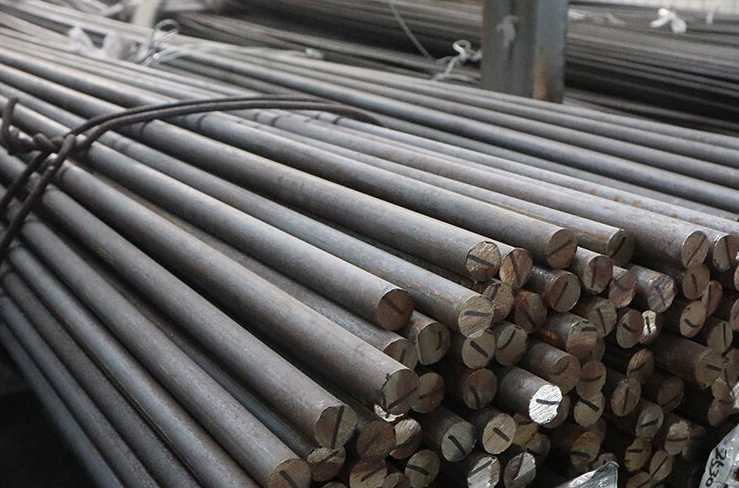
Due to their low cost, wide range of properties, and high volume of use, carbon structural steel round bars are widely used in various fields. The following are their main applications:
Machinery Manufacturing
Used to manufacture various mechanical transmission components such as drive shafts, gears, and sprockets, as well as fasteners like bolts and nuts, and parts subjected to alternating loads, such as engine connecting rods and pins.
Automotive Manufacturing
Used in components for chassis suspension, steering, and braking systems; critical parts such as engine connecting rods and piston pins; as well as non-load-bearing or secondary load-bearing structural components of the vehicle body.
Energy and Power Sector
Used in key components such as wind turbine towers and main shafts; support structures for power transmission and distribution towers; and parts for high-temperature, high-pressure equipment such as boilers and pressure vessels.
Rail Transit Sector
Used in track components such as railroad ties, spikes, and fasteners; structural components such as vehicle frames and bogies; and brake system components such as brake discs and brake drums.
Hardware and Household Goods Sector
Small-diameter round bars are drawn into wire for use in household items such as wire mesh, clothes hangers, and kitchen utensil racks. They are also widely used in the manufacture of various fasteners—including bolts, nuts, and rivets—as well as components for hand tools.
Chinese Standards (GB/T)
GB/T 699-2015, “High-Quality Carbon Structural Steel,” specifies the classification, designations, dimensions, shapes, and technical requirements for high-quality carbon structural steel bars. It applies to hot-rolled and forged high-quality carbon structural steel bars with a nominal diameter or thickness not exceeding 250 mm.
GB/T 700-2006 “Carbon Structural Steel” applies to hot-rolled steel plates, steel strips, structural sections, and steel bars that are generally used in their as-delivered condition and are typically employed in welded, riveted, or bolted engineering structures.
GB/T 8162-2018 “Seamless Steel Tubes for Structural Purposes” specifies the ordering requirements, dimensions, external shapes, and technical requirements for seamless steel tubes used in structural applications. GB/T 702-2017 “Dimensions, Shapes, Weights, and Permissible Deviations for Hot-Rolled Steel Bars” specifies the dimensional accuracy and tolerances for products such as hot-rolled round bars, square bars, and flat bars.
In addition, GB/T 715-1989 “Hot-Rolled Round Bars of Carbon Steel for Standard Parts” was previously used as the specification for round bars used in standard parts (this standard was repealed in 2017).
American Standards (ASTM)
ASTM A36/A36M is a standard specification for carbon structural steel; this grade is widely used in the manufacture of welded structural components for bridges, buildings, and other structures.
ASTM A105/A105M is a standard specification for carbon steel forgings used in pipeline components. The materials covered are low-carbon steels, primarily used for forged carbon steel pipeline components.
Additionally, ASTM A29/A29M, “General Requirements for Hot-Rolled Carbon and Alloy Steel Bars,” is a foundational standard for carbon and alloy steel bars, specifying general technical requirements for such bars.
British Standards (BS/BS EN)
BS EN 10025-2:2019, “Hot-rolled structural steel products—Part 2: Technical delivery conditions for non-alloy structural steels,” is the currently accepted standard for hot-rolled non-alloy structural steel products.
BS 4360, “Specification for Weldable Structural Steels,” was once an important standard for weldable structural steels (including round bars and square bars), but it has been superseded by the BS EN 10025 series and is now withdrawn.
Additionally, EN 10083-2, “Steels for Quenching and Tempering,” also applies to certain carbon steel round bar products.
Japanese Industrial Standards (JIS)
JIS G 3101, “Rolled Steel for General Structural Purposes,” specifies the technical requirements for SS-series carbon structural steels, which are suitable for general structural components such as bolts, nuts, and pins.
JIS G 4051, “Carbon Steel for Mechanical Structures,” specifies the technical requirements for the S-C series of carbon steels, which are suitable for mechanical structural applications such as shaft components, gears, and automotive parts.
Both standards provide specific provisions regarding the dimensions and tolerances of round bars.
International Standard (ISO)
ISO 1035:2026, “Hot-Rolled Steel Bars—Dimensions, Shapes, Mass, and Permissible Deviations,” is an international standard revised under China’s leadership. It specifies the dimensions, shapes, mass, and permissible deviations for hot-rolled steel bars (including round bars, square bars, flat bars, hexagonal bars, and octagonal bars), providing a unified technical basis for quality control in the production of hot-rolled steel bars and for international trade settlements worldwide. This standard consolidates the original ISO 1035-1 through 4 series of standards.
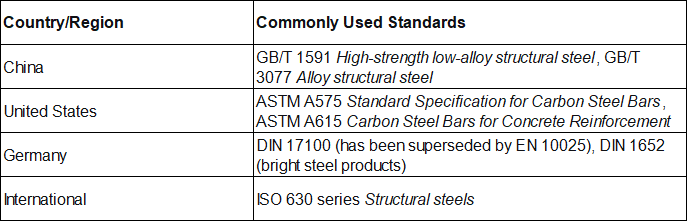
In addition to the above standard, various countries have a series of commonly used related standards available for reference:
Copyright Notice © 2022 - 2023 ChinaSteelMarket.com All rights reserved.