
Bridge steel plates are specialized thick steel plates used specifically for manufacturing bridge structural components. They are made from carbon steel and low-alloy steel used in bridge construction, and are distinguished from ordinary structural steel by the suffix "q" (bridge) in their steel grade. Bridge steel plates, also known as bridge construction steel plates, are a specialized type of steel plate used in the construction of bridges. Bridge steel plates are mainly used in the construction of highway bridges, railway bridges, and cross-sea bridges.
Bridges are critical infrastructure components that require durable and high-strength materials to support heavy loads, withstand harsh environmental conditions, and ensure long-term structural integrity. As key infrastructure bearing vehicle loads and impacts, bridges place extremely stringent requirements on the steel used. Bridge steel plates must possess high strength, high toughness, excellent fatigue resistance, good weldability, and resistance to atmospheric corrosion, while also requiring high surface quality.
Common bridge steel plate widths range from 1.0 to 2.4 meters, lengths from 2.0 to 16 meters, and thicknesses are generally 4.5 to 50 millimeters, with extra-thick plates reaching over 110 millimeters.
Core Performance Requirements
1. Strength and Toughness
Bridge steel plates must possess sufficient strength to withstand the static and dynamic loads of the bridge structure. Taking Q345qDNH weathering bridge steel as an example, its yield strength ≥ 400MPa, tensile strength ≥ 500MPa, and elongation ≥ 26%. For higher-strength steel plates, such as 500MPa grade bridge plates, the yield strength can reach over 500MPa, and the tensile strength ≥ 630MPa.
Regarding low-temperature toughness, bridge steel plates need to maintain good impact resistance in low-temperature environments. High-quality bridge steel plates can achieve an impact energy of over 250J at -60℃. The new standard GB/T 714-2025 also adds requirements for low-temperature impact toughness at -60℃.
2. Weldability
Bridge structure manufacturing and installation extensively utilize welding connections; therefore, the weldability of bridge steel plates is crucial. High-performance bridge steel, through measures such as reducing carbon content, can effectively reduce the hardness of the weld heat-affected zone, and in some cases, even avoid hydrogen-induced cracking without preheating. China has developed high-efficiency FCB welding technology for bridge and tunnel steel, achieving high heat input welding of 300 kJ/cm for steel plates with a maximum strength of 420 MPa.
3. Corrosion Resistance
Corrosion is one of the most significant failure modes of bridge structures. Weathering bridge steel, through the addition of alloying elements such as copper, chromium, and nickel, forms a dense, special rust layer in the air, effectively isolating it from corrosive media. Its corrosion resistance is 2 to 8 times that of ordinary carbon steel. Weathering bridge steel can be used without painting, reducing overall manufacturing costs by more than 23%, making it a green and environmentally friendly bridge steel material.
4. Fatigue Resistance
Bridges endure repeated vehicle loads over long periods during their service life, and fatigue failure is one of the main failure modes of bridge steel structures. Therefore, bridge steel plates must possess excellent fatigue resistance to ensure safe and reliable operation for decades.
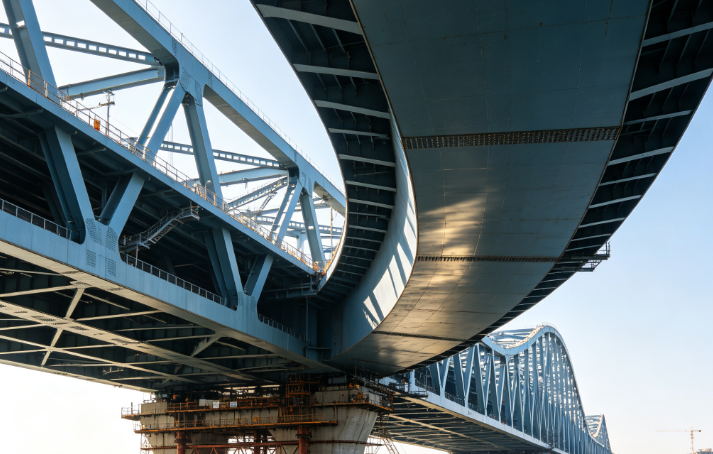
Bridge steel plates are specifically designed and manufactured to meet the stringent requirements of bridge construction. They are typically made from carbon steel or low-alloy steel, and this making technology provides excellent mechanical properties such as high tensile strength, impact resistance, and fatigue strength. These properties are essential for standing the dynamic forces exerted on bridges, including the weight of vehicles, wind loads, and seismic activity.
The steel used for bridge plates undergoes a rigorous manufacturing process to ensure uniformity and consistency in its mechanical properties. It is often produced through controlled rolling, heat treatment, and precise alloying techniques to achieve the desired strength and toughness. Additionally, the steel plates may undergo processes such as quenching and tempering to enhance their hardness and resilience.
Bridge steel plates come in various dimensions, thicknesses, and grades, depending on the specific requirements of the bridge design and construction. They are typically fabricated in large sizes to cover the surface area of the bridge deck and provide adequate load-bearing capacity. The plates are commonly joined together through welding or bolted connections to form a continuous and stable deck surface.
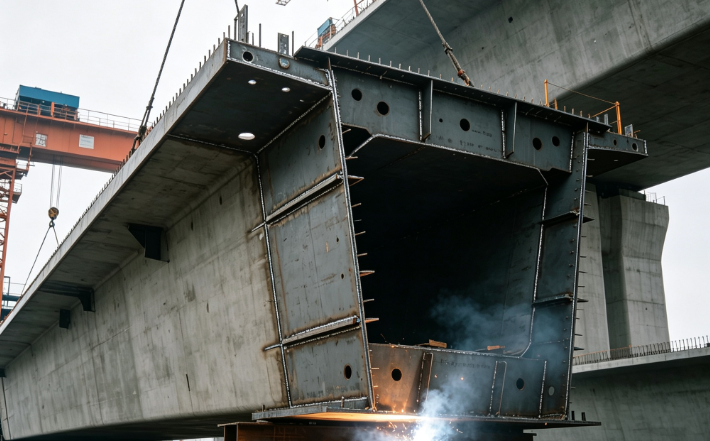
In conclusion, bridge steel plates are specialized steel components used in the construction of bridges. They offer exceptional strength, durability, and resistance to various forces, ensuring the structural integrity and safety of bridges for long-term use.
In conclusion, bridge steel plates are specialized steel components used in the construction of bridges. They offer exceptional strength, durability, and resistance to various forces, ensuring the structural integrity and safety of bridges for long-term use.
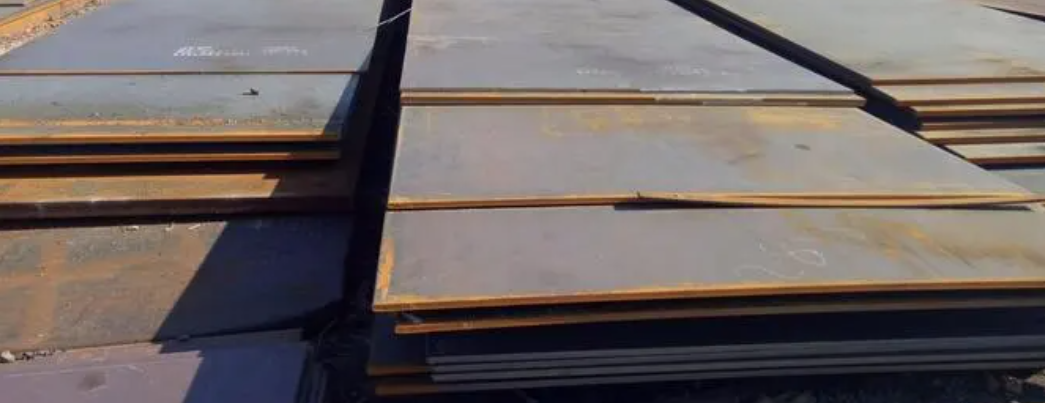
The common steel standards for bridge steel plates in China, the USA, the UK, and Japan are as follows:
China Standard:
GB/T 714-2015: Structural steel for bridge.
This standard applies to structural steel plates for bridges with a thickness not greater than 150mm, structural steel strips and shear steel plates for bridges with a thickness not greater than 25.4mm, and structural steel for bridges with a thickness not greater than 40mm.
GB/T 1591-2018: High strength low alloy structural steels.
This standard applies to low-alloy high-strength structural steel plates, steel strips, section steel, steel bars, etc. for general structures and engineering. Its chemical composition is also suitable for steel billets.
American standard:
ASTM A709/A709M-18: Standard Specification for Structural Steel for Bridges: This standard specifies the requirements for structural steel plates and strips applicable to bridge structures.
ASTM A572/A572M-18: Standard Specification for High-Strength Low-Alloy Columbium-Vanadium Structural Steel: This standard covers the requirements for high-strength low-alloy steel plates and strips applicable to bridge structures.
British Standards:
BS EN 10025-2:2004: Hot rolled products of structural steels - Part 2: Technical delivery conditions for non-alloy structural steels: This standard specifies the requirements for non-alloy structural steel plates and strips suitable for bridge structures. This standard specifies the requirements for the technical delivery conditions for non-alloy structural steel plates and strips suitable for bridge structures.
BS EN 10210-1:2006: Hot finished structural hollow sections of non-alloy and fine grain steels - Part 1: Technical delivery requirements: This standard specifies the requirements for the technical delivery of non-alloy structural steels and steel strips applicable to bridge structures.
Japanese Standards:
JIS G3106-2008: Rolled steels for welded structure: This standard covers the requirements for hot-rolled steel plates and strips suitable for bridge structures.
JIS G3101-2019:Rolled steels for general structure: This standard covers the requirements for general structure steel plates and strips applicable to bridge structures.
Copyright Notice © 2022 - 2023 ChinaSteelMarket.com All rights reserved.