
Acid-resistant steel is a special type of steel that exhibits excellent corrosion resistance in acidic media through special alloy design and processing. It achieves this by forming a dense oxide film or passivation layer on its surface, increasing its corrosion resistance by more than 10 times compared to ordinary carbon steel.
Conceptually, acid-resistant steel is similar in meaning to "stainless steel"—the commonly used term "stainless and acid-resistant steel" is the full name for stainless steel. However, in engineering practice, the two emphasize different aspects: stainless steel is a broader concept, encompassing steels that resist rust in mild environments such as air and fresh water; while acid-resistant steel emphasizes its corrosion resistance in specific acidic media such as sulfuric acid, nitric acid, phosphoric acid, and acetic acid.
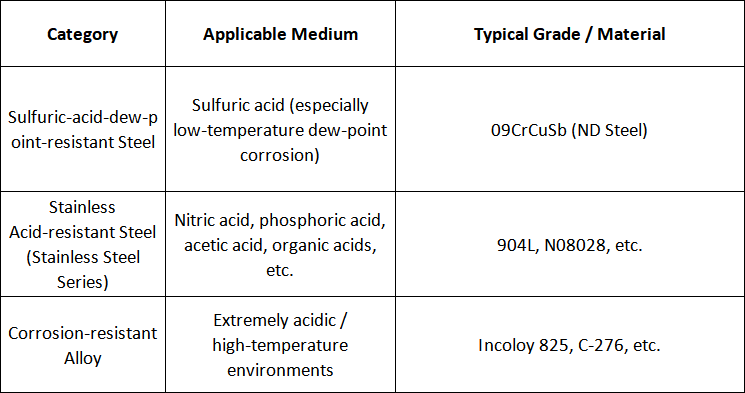
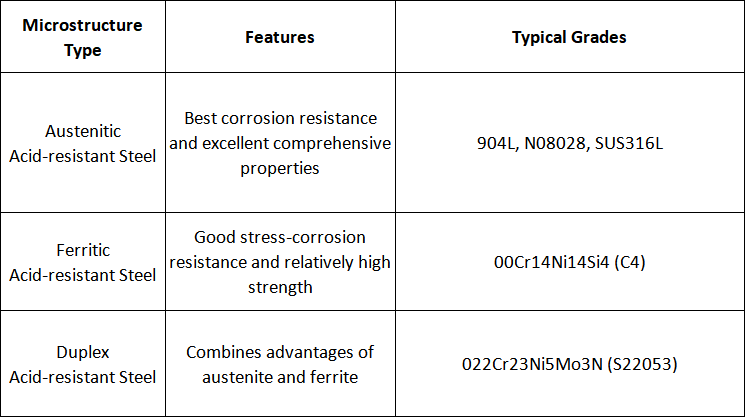
Acid-resistant steel can be divided into two main categories according to the type of corrosive media and alloy system:
1. Classification by corrosion-resistant media
2. Classification by metallographic structure (stainless steel-acid-resistant steel)
Core Performance Characteristics
1. Excellent Acid Resistance
The core performance characteristic of acid-resistant steel is maintaining an extremely low corrosion rate in specific acidic media. Its corrosion resistance is more than 10 times higher than that of ordinary carbon steel.
Different grades of acid-resistant steel have their own preferred media:
904L: Excellent corrosion resistance in sulfuric acid of various concentrations below 70℃; resistant to acetic acid and formic acid mixtures of any concentration and temperature at normal pressure.
N08028: Maintains a low corrosion rate in 60-80% concentrated sulfuric acid below its boiling point.
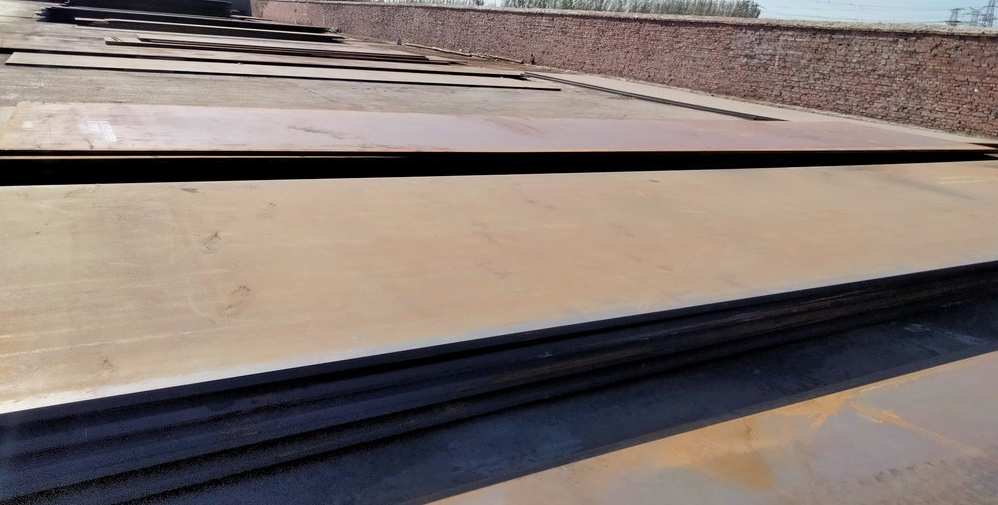
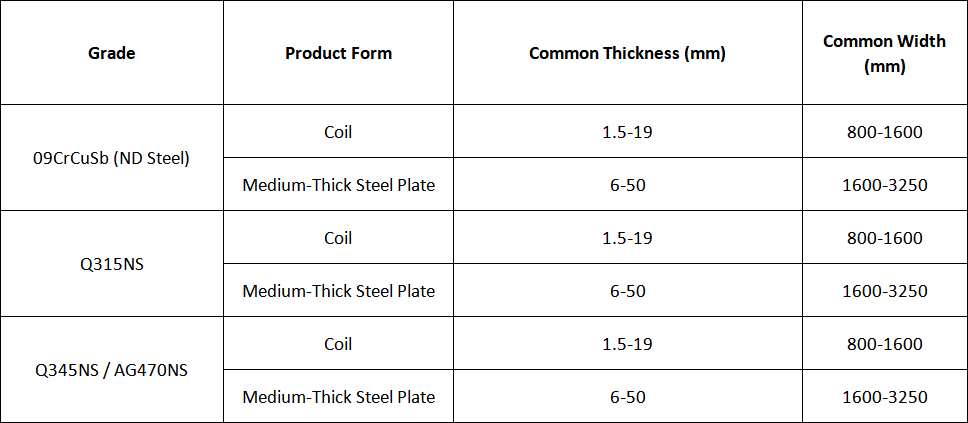
09CrCuSb (ND steel): Specializes in sulfuric acid dew point corrosion scenarios.
2. Good Mechanical Properties
Taking N08028 as an example: In the solution-treated state, its room temperature tensile strength ≥600MPa, yield strength ≥280MPa, and elongation ≥40%. 904L has a tensile strength ≥520MPa and an elongation ≥35%.
3. Resistance to Localized Corrosion
High-alloy acid-resistant steels (such as 904L and N08028) possess good resistance to pitting corrosion, crevice corrosion, and stress corrosion, which is particularly important in acidic environments containing chloride ions.
4. Excellent Processing Properties
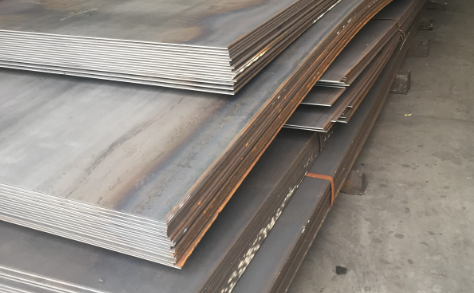
Acid-resistant steel typically possesses excellent cold and hot working properties and weldability, and can be manufactured into various forms such as plates, bars, tubes, and forgings.
Production Process
The production of acid-resistant steel involves two core aspects: special alloy design and precision process control.
Alloy Design: Precisely proportioning elements such as chromium, nickel, molybdenum, copper, and antimony to target corrosive media.
Smelting and Continuous Casting: Strictly controlling composition and purity to prevent segregation.
Hot Rolling/Cold Rolling: Utilizing controlled rolling and cooling processes to optimize microstructure and properties.
Heat Treatment: Typically delivered in a solution-treated state to ensure uniform microstructure and optimal corrosion resistance.
Surface Treatment: Options such as pickling, sandblasting, or polishing are available.
Taking Jiugang's production of 09CrCuSb as an example, to address challenges such as sensitivity to edge cracks and unstable cold bending performance, technicians refined smelting and rolling process parameters, optimized composition design and continuous casting processes, and successfully achieved mass production at the hundred-ton level.
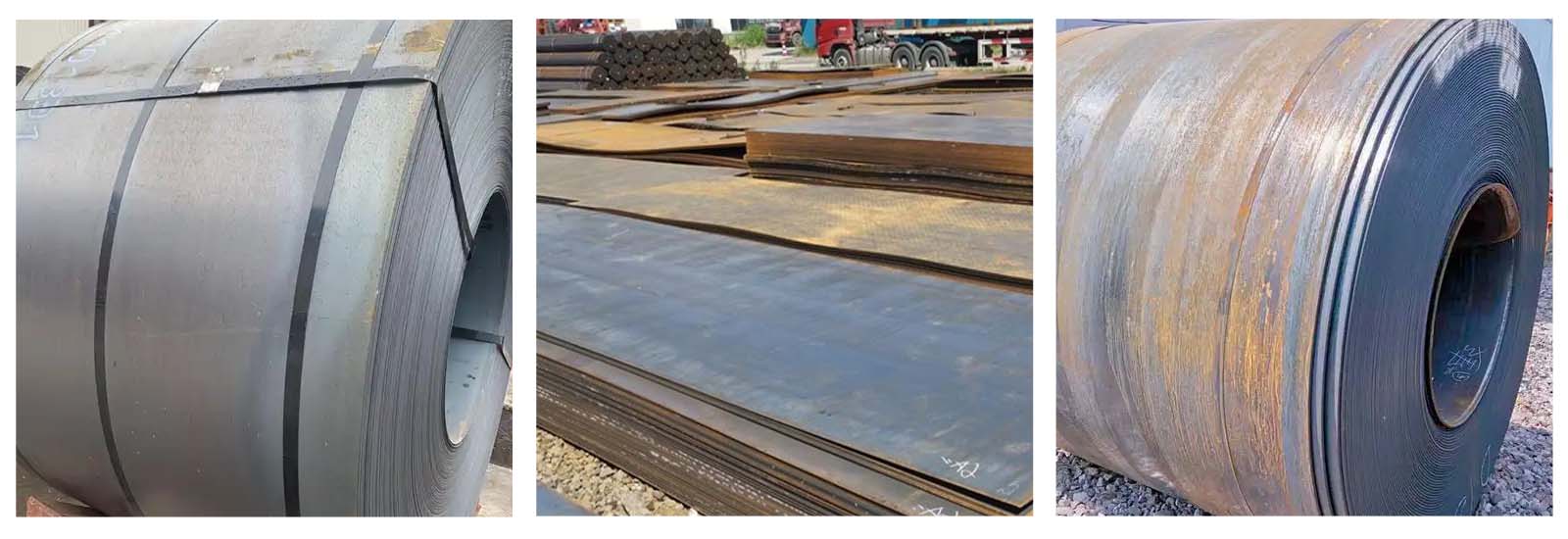
It's important to note that while acid-resistant round steel provides excellent corrosion resistance, it may not be immune to all types and concentrations of acids. The selection of the appropriate grade of acid-resistant steel depends on the specific corrosive environment and concentration of acids.
In China, acid-resistant round steel is typically manufactured and specified in accordance with Chinese national standards known as GB/T (Guo Biao Tuijian) standards. The main GB/T standard for acid-resistant round steel is:
GB/T 1220: This standard specifies the requirements for stainless steel bars, including round bars, square bars, hexagonal bars, and other shapes. GB/T 1220 includes various grades of stainless steel, some of which offer enhanced resistance to acidic environments.
GB/T 1220 covers stainless steel grades such as 1Cr18Ni9, 1Cr18Ni11Nb, 1Cr17Ni7, 0Cr18Ni11Nb, 0Cr18Ni9, and others, which are suitable for use in corrosive conditions, including exposure to acids.
This standard outlines the chemical composition, mechanical properties, heat treatment, and testing requirements for acid-resistant round steel. It provides guidelines for material selection, manufacturing processes, and quality control to ensure the performance and durability of acid-resistant steel in acidic environments.
In the United States, acid-resistant round steel is typically manufactured and specified in accordance with various ASTM (American Society for Testing and Materials) standards that define the chemical composition, mechanical properties, and other characteristics of the material. Some of the commonly used ASTM standards for acid-resistant round steel include:
ASTM A276/A276M: This specification covers stainless steel bars and shapes, including round bars, that are used for a wide range of applications, including resistance to acidic environments. It includes various grades of stainless steel that exhibit different levels of acid resistance, such as austenitic, ferritic, and duplex stainless steels.
ASTM A479/A479M: Similar to ASTM A276/A276M, this specification covers stainless steel bars, including round bars, for use in corrosive environments and other general applications.
ASTM A193/A193M: This specification covers alloy and stainless steel bolting materials for high-temperature or high-pressure service. Some grades within this specification can offer acid resistance, particularly in elevated temperature environments.
ASTM A314: This specification covers stainless steel billets and bars for forging, which can be used for acid-resistant round steel applications.
NACE MR0175/ISO 15156: While not an ASTM standard, NACE MR0175/ISO 15156 is an internationally recognized standard that addresses the requirements for carbon and low-alloy steels exposed to acidic environments containing hydrogen sulfide (H2S). It provides guidelines for selecting suitable materials and manufacturing methods to prevent sulfide stress cracking and hydrogen-induced cracking.
These ASTM standards provide guidelines for material selection, manufacturing processes, and testing to ensure the quality and performance of acid-resistant round steel in various corrosive environments. The specific grade of acid-resistant steel to be used depends on the type of acid or corrosive substance it will encounter, the concentration and temperature of the solution, and other environmental factors.
In the United Kingdom, acid-resistant round steel is commonly specified and manufactured in accordance with various British Standards (BS) and European Standards (EN) that define the requirements for this type of material. The most relevant standards for acid-resistant round steel in the UK are:
BS EN 10088-3: This European Standard specifies the technical delivery conditions for semi-finished products, bars, rods, wire, sections, and bright products of corrosion-resistant stainless steels for general purposes. It includes various grades of stainless steel that offer resistance to acidic environments.
BS EN 10095: This European Standard specifies the requirements for heat-resisting steel and nickel alloys in the form of bars, forgings, and plates for use in corrosive environments, including acids.
BS 6744: This British Standard covers stainless steel bars for the reinforcement of and use in concrete. Although primarily focused on concrete reinforcement, it includes grades suitable for acid-resistant applications.
NACE MR0175/ISO 15156: While not a British or European standard, NACE MR0175/ISO 15156 is an internationally recognized standard that addresses the requirements for carbon and low-alloy steels exposed to acidic environments containing hydrogen sulfide (H2S). It provides guidelines for selecting suitable materials and manufacturing methods to prevent sulfide stress cracking and hydrogen-induced cracking.
In Japan, acid-resistant round steel is typically specified and manufactured in accordance with Japanese Industrial Standards (JIS) that define the requirements for this type of material. The most relevant JIS standard for acid-resistant round steel is:
JIS G4303: This Japanese Industrial Standard specifies the requirements for stainless steel bars, including round bars, for general applications. It covers various grades of stainless steel, including those with enhanced resistance to acidic environments.
JIS G4303 includes several stainless steel grades suitable for different corrosive environments, including acids. Some of the common grades used for acid-resistant applications include SUS304, SUS316, SUS321, SUS347, and others. These grades offer varying levels of corrosion resistance and mechanical properties, making them suitable for a wide range of acidic conditions.
JIS G4303 outlines the chemical composition, mechanical properties, heat treatment, and testing requirements for acid-resistant round steel. It is an important standard for material selection and manufacturing processes to ensure the quality and performance of acid-resistant steel in corrosive environments.
Copyright Notice © 2022 - 2023 ChinaSteelMarket.com All rights reserved.