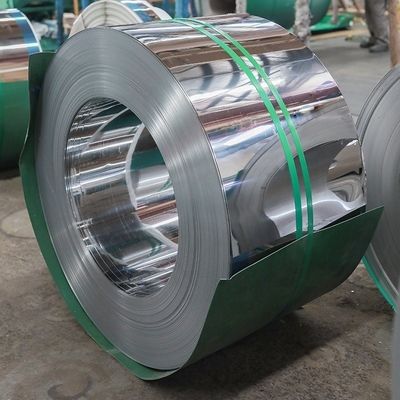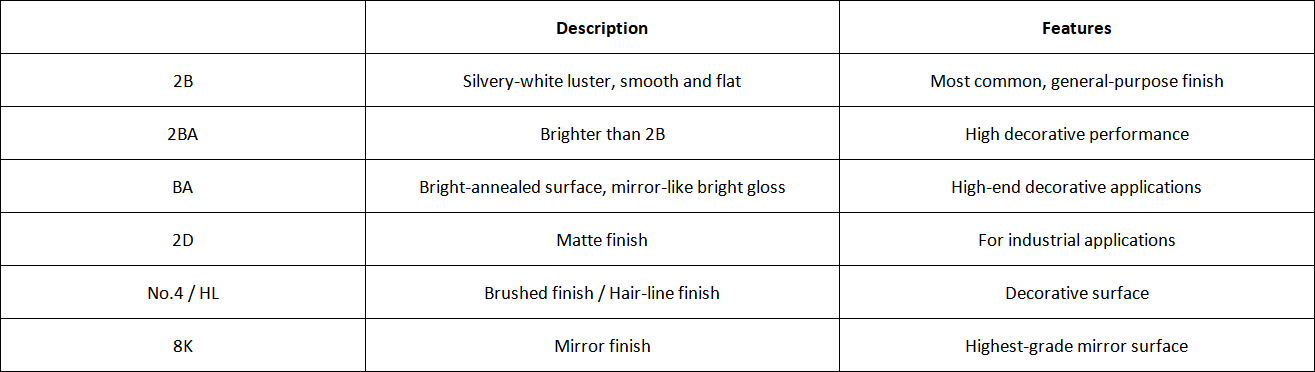

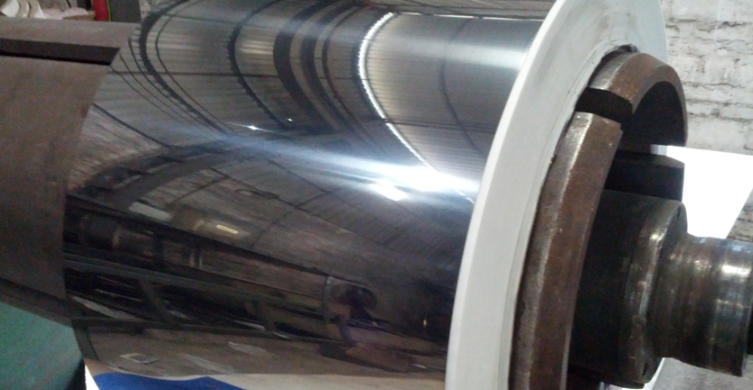
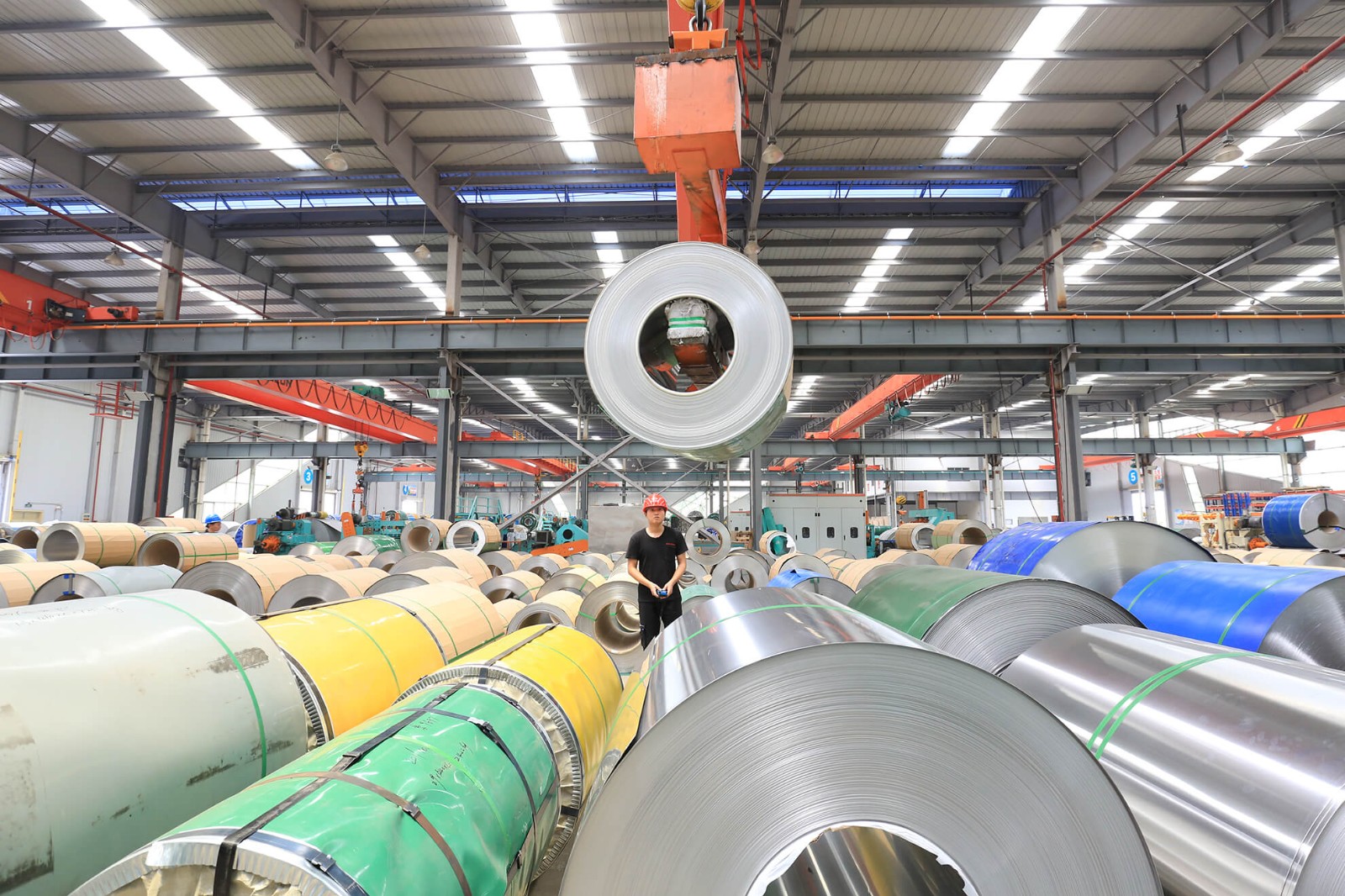
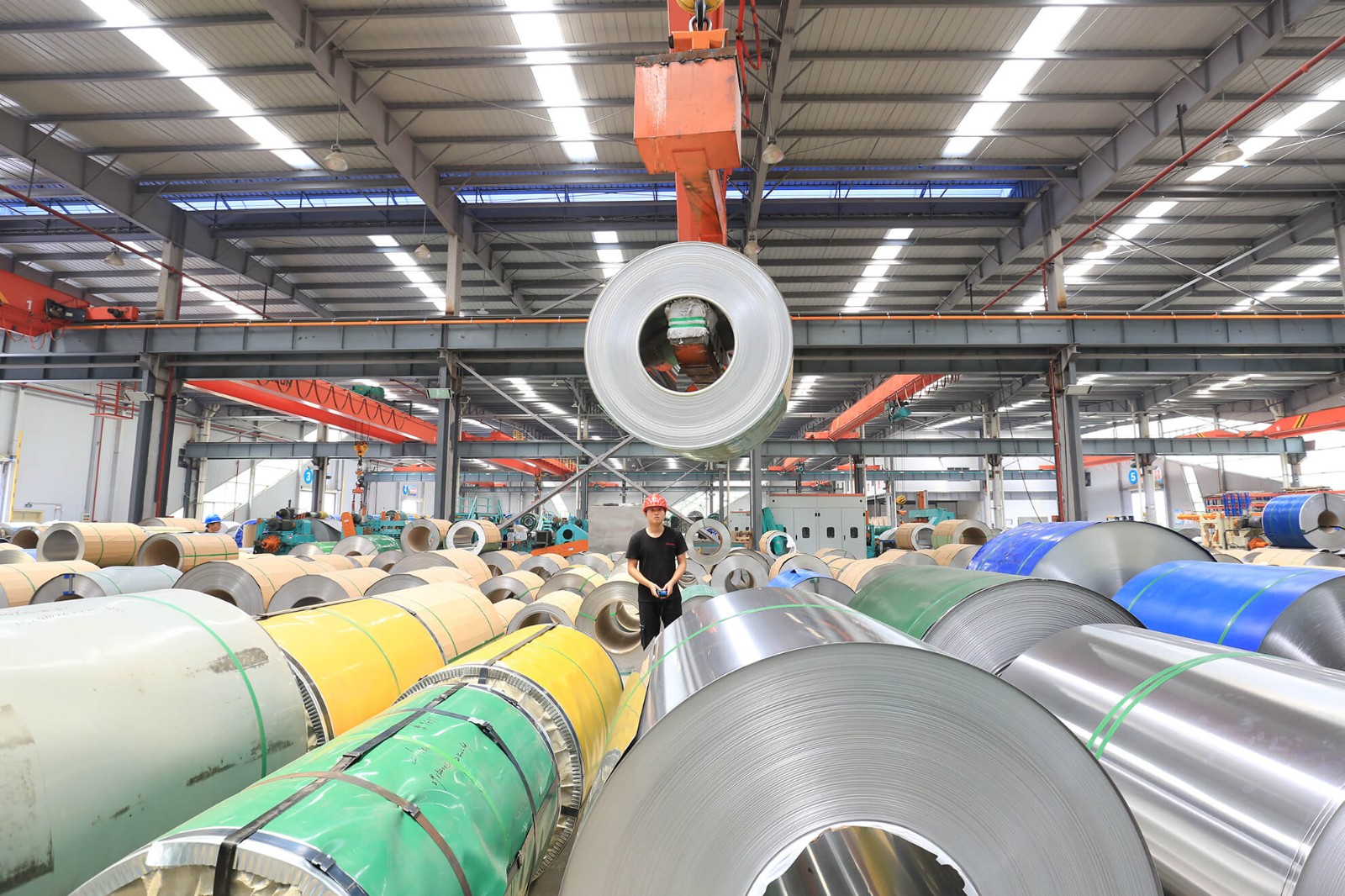
400 series cold-rolled stainless steel coils are sheet and strip products made from 400 series stainless steel hot-rolled coils through a cold-rolling process. 400 series stainless steel belongs to the chromium-based ferritic and martensitic stainless steel family, renowned for its nickel-free or trace nickel content, lower cost, and ability to maintain good corrosion resistance and mechanical properties. The superior cold-rolling process further improves the product's dimensional accuracy, surface finish, and mechanical properties.
Compared to 200 and 300 series cold-rolled coils, 400 series cold-rolled coils do not contain expensive nickel; therefore, their price is significantly lower than 300 series austenitic stainless steel, earning them the title of "economical" stainless steel.
400 series stainless steel is magnetic, which is one of the most intuitive ways to distinguish it from 300 series austenitic stainless steel.
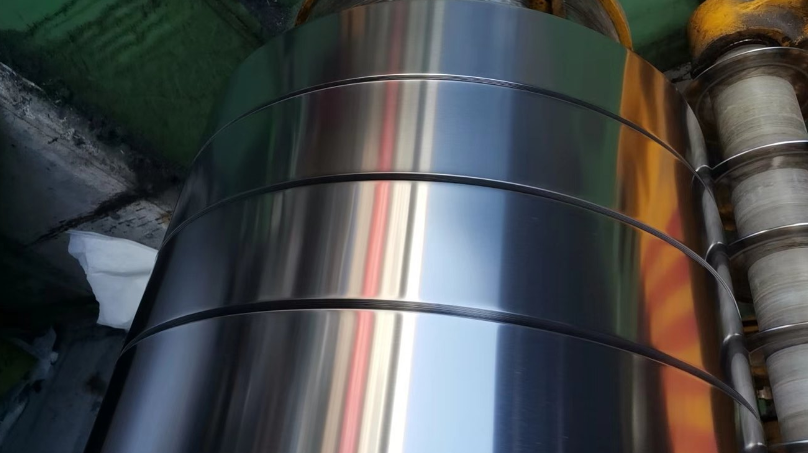
400 series cold-rolled stainless steel coils can be divided into two main categories according to their metallographic structure: ferritic stainless steel and martensitic stainless steel.
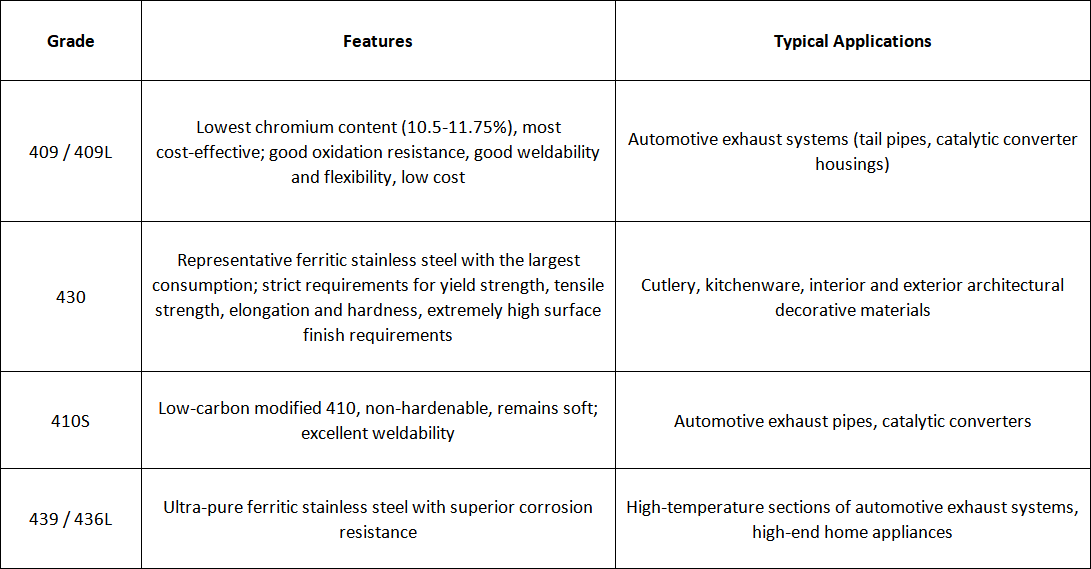
1. Ferritic Stainless Steel:
Ferritic stainless steel typically has a chromium content between 11% and 30%, contains no nickel, and possesses good formability, corrosion resistance, and oxidation resistance.
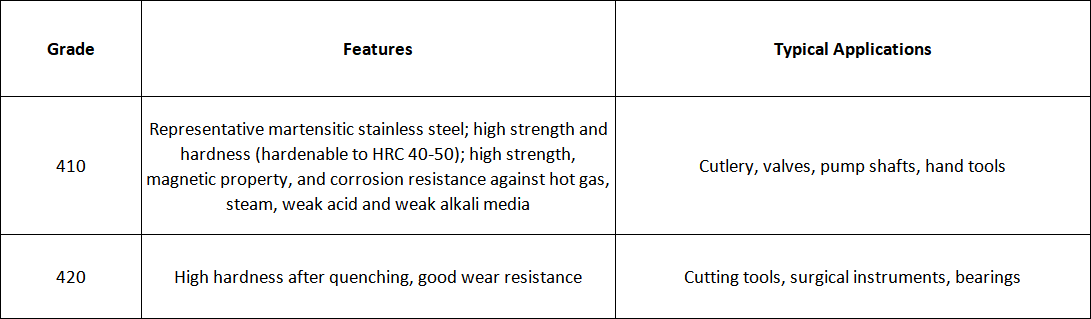
2. Martensitic Stainless Steel:
Martensitic stainless steel has a chromium content of approximately 13% and can undergo quenching heat treatment to improve its hardness and strength.
Core Advantages
1. Low Cost: Nickel-free or containing only trace amounts of nickel, significantly lower price than 300 series.
2. Resource Conservation: Low nickel content helps reduce domestic dependence on imported nickel.
3. Low Price Fluctuation: Relatively stable price due to minimal impact from nickel price fluctuations.
4. Low Coefficient of Thermal Expansion: Linear expansion coefficient is 60% of that of austenitic stainless steel, resulting in less stress and deformation during temperature changes.
5. Green and Low-Carbon: 400 series stainless steel is recognized as a green and low-carbon product.
6. Good Overall Performance: Excellent corrosion resistance and oxidation resistance.
7. Magnetic Properties
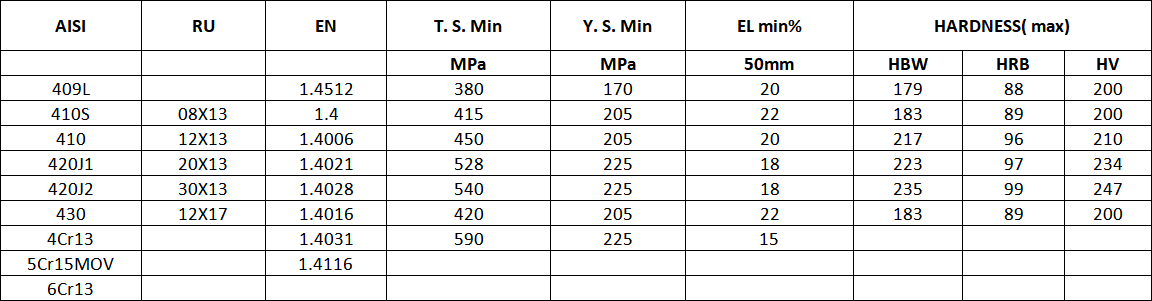
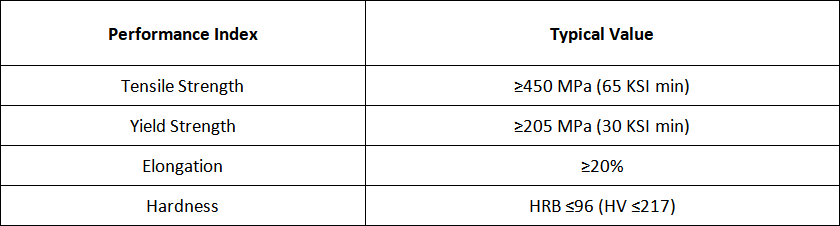
Typical mechanical properties (taking 410 cold-rolled coil as an example)
Main limitations:
1. Slightly poorer formability: Ferritic stainless steel has slightly worse formability than austenitic stainless steel.
2. Limited corrosion resistance: Easily corroded in severely corrosive atmospheres.
3. Weldability is inferior to 300 series stainless steel.
Used in automotive exhaust systems (USA 35%, EU 40%, Japan 100%), high-temperature ranges above 600℃, and for exhaust straight pipes (409L, 436L, 444) considering thermal fatigue. In the low-temperature range (below 600℃), it is used for front mufflers, tailpipes, catalytic converters, etc. (439, 441, 429); In the home appliance industry: microwave oven inner liner (430, 430BA), washing machine inner drum (430, 439, 430J1), LCD monitor frame (409L), range hood (430, 439); In the hardware industry: tableware, kitchen sinks, soup containers, composite pot bottoms, etc. (430), heat-resistant appliances (409L, 444); solar water heaters for gas appliances (444); In the decorative materials industry: balcony railings (439), elevator doors (439, 440); In the construction industry: roofing materials (445, 446M), modular water tanks, water intake pools (444); refrigerated container shells (409L, 430), minting, etc.
Currently, medical institutions also widely use 430 steel to make medical cabinets, dissection tables, and disinfection pools.
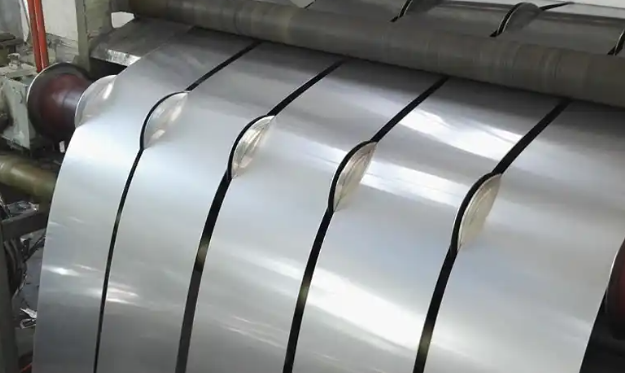
400 series cold-rolled stainless steel coils are "economical" stainless steel products containing little or no nickel, represented by 430 (ferritic) and 410 (martensitic). Compared to 300 series cold-rolled coils, its core advantages are lower price (approximately 55-60% of 304), lower coefficient of thermal expansion (only 60% of austenitic), less price fluctuation, and magnetic properties; its core limitations are lower formability and weldability compared to 300 series.
The largest application area for 400 series cold-rolled coils is automotive exhaust systems (reaching 100% penetration in Japan), and they are also widely used in home appliance panels, architectural decoration, elevators, kitchen and bathroom appliances, heat exchangers, and other fields. With continuous capacity expansion (production reached 3.51 million tons in the first half of 2024, a year-on-year increase of 16.25%) and high-end development, 400 series cold-rolled coils are gradually replacing some 300 series products and finding applications in more fields.





|

|

|

|

|
| Timely Info | Independent | Platform | Multiple guarantees | Self-operated storage |
China Steel Market
Empowering small and medium-scale steel purchasing

| About us | Channel | Useful tools |
|---|---|---|
| About China Steel Market | Prices | Steel Weight Calculation |
| Contact Us | Answers | Why Choose Us |
| Terms & Conditions | Inventory | |
| Privacy Policy | Help |
Hot search words:
China Rebar prices China Wire Rod Prices Welded Steel Pipe Prices