
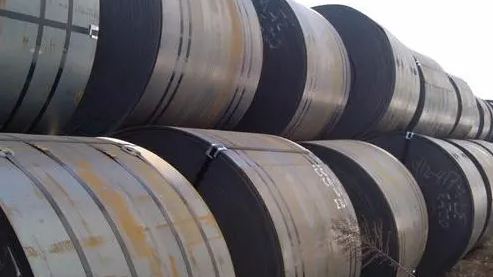
Hot-rolled pickled coils refer to steel products made from high-quality hot-rolled steel coils, which undergo pickling to remove surface iron oxide scale (commonly known as "black scale"), followed by finishing processes. Hot-rolled pickled coils are a high-value-added steel product that falls between ordinary hot-rolled plates and cold-rolled plates. It is made from hot-rolled thin plates, which are then pickled to remove the surface oxide layer and finished. Its surface quality and usage requirements are between those of hot-rolled plates and cold-rolled plates, making it an ideal substitute for some hot-rolled and cold-rolled plates.

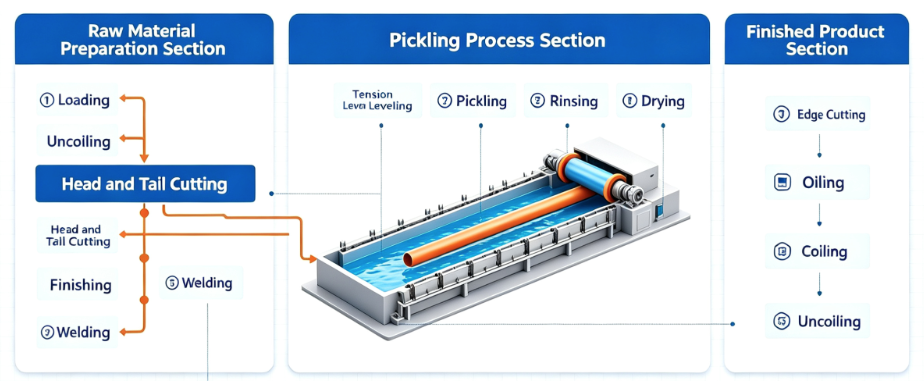
The core process of hot-rolled pickled coils lies in "pickling"—a method that uses acid solutions such as hydrochloric acid to remove iron oxide scale and rust from the surface of hot-rolled steel plates.
Hot Rolling:
HRPC starts as a standard hot-rolled steel coil. Hot rolling is a metalworking process in which steel is heated above its recrystallization temperature and then passed through rollers to achieve the desired thickness and shape. This process allows the steel to be formed into coils, sheets, or plates.
Pickling:
After the hot rolling process, the steel often contains impurities such as oxides, scales, and other surface contaminants. To enhance the quality and finish of the steel, it undergoes a pickling treatment. Pickling involves immersing the steel coil in an acid solution, usually a mixture of hydrochloric acid (HCl) or sulfuric acid (H2SO4), which removes these impurities from the surface.
Scale Removal:
The acid solution dissolves the surface oxides and scales, leaving behind a clean surface free from impurities. This process not only improves the appearance of the steel but also enhances its mechanical properties.
Oil Coating:
After pickling, the steel is rinsed and coated with a thin layer of oil to prevent rusting during storage and transportation.
The benefits of Hot Rolled Pickled Coil include:
Improved Surface Finish: HRPC has a smoother and cleaner surface compared to regular hot-rolled coils, making it more aesthetically appealing and suitable for applications where appearance matters.
Better Welding and Forming Properties:
The removal of surface impurities improves the weldability and formability of the steel, making it easier to work with in various manufacturing processes.
Enhanced Corrosion Resistance:
The oil coating applied after pickling provides temporary protection against rusting, ensuring that the steel remains in good condition until further processing or usage.
Uniform Thickness:
HRPC is often more consistent in thickness and dimension compared to non-pickled hot-rolled coils, reducing variations during subsequent processing stages.
Core Performance Characteristics
1. Excellent Surface Quality: After pickling removes the iron oxide scale, the surface has a high degree of smoothness and uniformity, facilitating subsequent welding, oiling, and painting.
2. Stable dimensional accuracy: After leveling and finishing, the dimensional accuracy is higher than that of ordinary hot-rolled plates.
3. Good processing performance. Suitable for cold bending, stamping and other processing. Taking SAPH370 as an example, when the thickness is less than 8mm, the yield strength is ≥225MPa and the elongation after fracture is as low as 32%.
4. High cost-performance ratio. The price is between that of hot-rolled and cold-rolled steel. Compared with cold-rolled steel, it can reduce costs by about 10%, making it a high value-added product.
Application field:
Hot rolled pickled coil refers to the steel produced in the hot-rolling process with iron scale, scale and rust on the surface after pickling. It has high surface flatness, uniform texture, low corrosion degree, and low cost. low-level features. Hot-rolled pickled steel coils are widely used in many fields, such as automobile industry, construction industry, home appliance manufacturing industry, shipbuilding industry, electronics industry, pipeline engineering, etc.
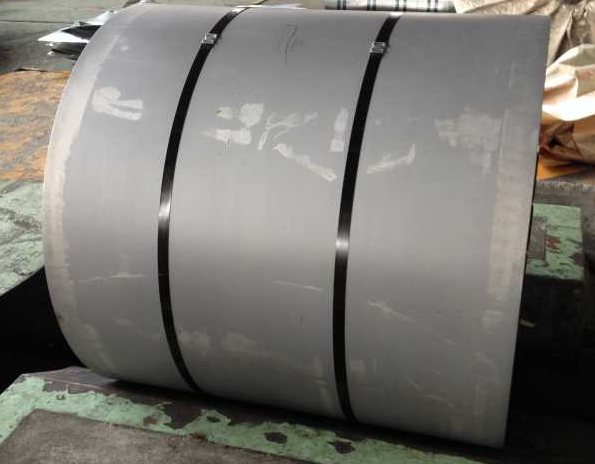
Hot-rolled pickled coils are intermediate products that remove oxide scale from the surface of hot-rolled plates through a pickling process, resulting in good surface quality and high cost-effectiveness. It is made from hot-rolled coils through processes such as pickling, leveling, and finishing, and complies with the GB/T 38813-2020 standard. The products have a high surface finish and stable dimensional accuracy, and are widely used in the automotive, home appliance, and machinery manufacturing industries. Since Baosteel's first production line went into operation in 2001, my country's hot-rolled pickled coil industry has developed rapidly and is constantly evolving towards higher surface quality, more environmentally friendly processes, and broader application areas.
In China, the standards for Hot Rolled Pickled Coil (HRPC) are set by the Chinese National Standards (GB/T - Guo Biao Tuijian). The relevant standard for HRPC in China is:
GB/T 700: This Chinese standard specifies the carbon structural steels, which also include HRPC. GB/T 700 covers a wide range of grades and designations of HRPC, including Q195, Q215, Q235, Q275, and others. Each grade has specific chemical composition and mechanical properties suitable for various applications.
GB/T 700 outlines the requirements for chemical composition, mechanical properties, and other technical specifications for HRPC. It ensures that the HRPC produced in China meets consistent quality standards and is suitable for use in various industries, including construction, manufacturing, and general engineering.
In the United States, the most commonly referenced standard for Hot Rolled Pickled Coil (HRPC) is issued by the American Society for Testing and Materials (ASTM). The relevant ASTM standard for HRPC in the US is:
ASTM A1011 / A1011M: This specification covers hot-rolled, carbon, structural, high-strength low-alloy, high-strength low-alloy with improved formability, and ultra-high strength steel sheet and strip in coils. It is applicable to various grades of HRPC used in a wide range of industries and applications. ASTM A1011 outlines the general requirements for HRPC, including chemical composition, mechanical properties, and tolerances.
ASTM A1011 provides different grades of HRPC, identified by designations such as CS (Commercial Steel), DS (Drawing Steel), DDS (Deep Drawing Steel), SS (Structural Steel), HSLAS (High-Strength Low-Alloy Steel), and UHSS (Ultra-High Strength Steel). Each grade has specific characteristics suited for particular applications.
In the United Kingdom, the most commonly referenced standard for Hot Rolled Pickled Coil (HRPC) is issued by the British Standards Institution (BSI). The relevant BSI standard for HRPC in the UK is:
BS EN 10111:2008: This European standard specifies the requirements for continuously hot-rolled low carbon steel sheet and strip for cold forming. It covers HRPC with specific chemical composition and mechanical properties suitable for cold forming processes. The standard provides various grades and designations of HRPC, and it outlines the tolerances, dimensions, and other technical delivery conditions.
BS EN 10111:2008 applies to HRPC used in a wide range of applications, including construction, automotive manufacturing, and general engineering. The standard ensures that the HRPC produced and used in the UK adheres to consistent quality and performance requirements, promoting compatibility with various downstream processes.
In addition to BS EN 10111, other relevant standards related to HRPC in the UK may include those issued by the European Committee for Standardization (CEN) and the International Organization for Standardization (ISO). These standards are often adopted or incorporated into British standards to ensure alignment with European and international norms.
In Japan, the standards for Hot Rolled Pickled Coil (HRPC) are set by the Japanese Industrial Standards (JIS). The relevant JIS standard for HRPC in Japan is:
JIS G3131: This standard specifies the requirements for hot-rolled mild steel plates, sheets, and strips. It covers a wide range of grades and designations of HRPC, including SPHC (general use), SPHD (drawing), SPHE (deep drawing), SPHF (extra deep drawing), and others. Each grade has specific chemical composition and mechanical properties suitable for various applications.
JIS G3131 outlines the dimensions, shape, mass, permissible variations, and other technical requirements for HRPC. It ensures that the HRPC produced in Japan meets consistent quality standards and is compatible with different manufacturing processes and applications.

Copyright Notice © 2022 - 2023 ChinaSteelMarket.com All rights reserved.