
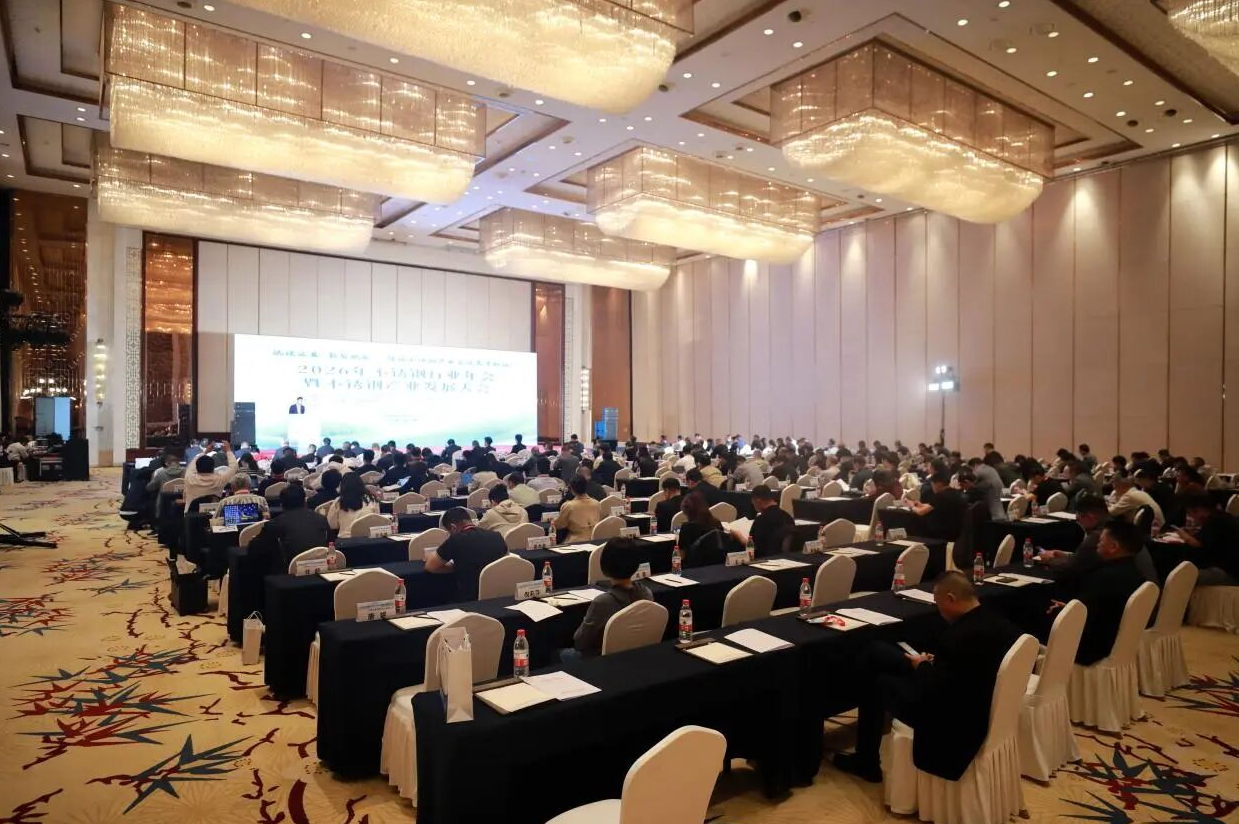
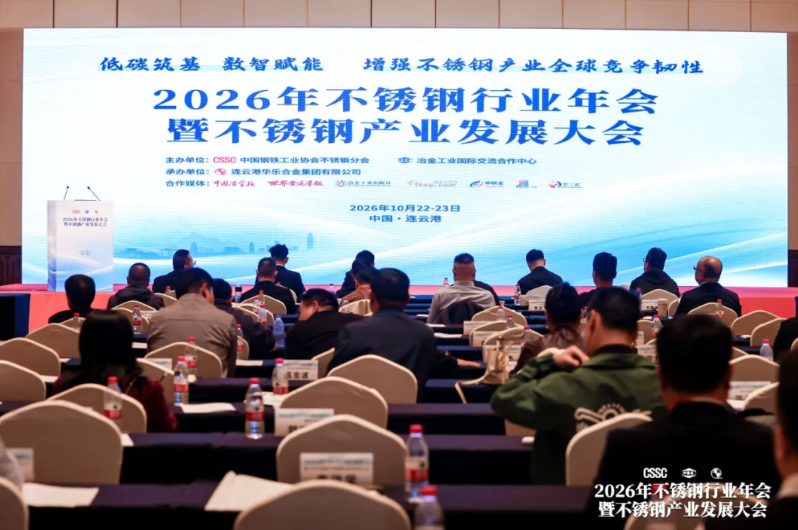
The 2026 Stainless Steel Industry Annual Meeting and Stainless Steel Industry Development Conference is held in Lianyungang.
On October 23, the 2026 Stainless Steel Industry Annual Conference and Stainless Steel Industry Development Summit was held in Lianyungang, Jiangsu Province, drawing over 260 representatives from across the industrial chain. In his address, Li Yiren, a member of the Party Committee and Vice Chairman of the China Iron and Steel Association, noted that while stainless steel production has maintained steady growth—even as national steel output has declined for consecutive years—capacity utilization rates and corporate profitability have both seen a marked downturn. The industry is currently grappling with a complex set of challenges, including heightened supply-demand pressure, intensifying "involution" (hyper-competition) driven by product homogenization, volatile raw material and fuel costs, and sluggish progress in the development of high-end products. Consequently, the sector has reached a critical juncture, necessitating a transition from a focus on "scale expansion" toward "structural adjustment" and "quality and efficiency improvement."
Operational data provides clear support for this assessment. In 2025, China’s crude stainless steel production reached 40.8681 million tonnes, a year-on-year increase of 3.62%, while apparent consumption stood at 33.4616 million tonnes, up 2.98%. In the first eight months of 2026, crude stainless steel production hit 28.354 million tonnes—a 6.70% year-on-year rise—and apparent consumption reached 23.77 million tonnes, an increase of 9.58%. While China continues to lead the world in total volume, there is a marked divergence in profitability across the industrial chain: upstream smelting and rolling enterprises are seeing revenue growth without a corresponding rise in profits, while downstream manufacturers of pipes and deep-processed products are facing pressure regarding orders. Notably, the growth rates for 400-series and duplex stainless steels have significantly outpaced those of the 200-series and 300-series; production of duplex stainless steel, for instance, surged by 17.90% year-on-year during the first eight months. This indicates an accelerating structural upgrade, driven by a combination of both proactive strategic shifts and reactive market pressures.
Facing this difficult situation, Li Yiren has proposed five areas for concerted action: strengthening industry self-regulation, adopting a rational and prudent approach to investment, and moving away from low-price competition based on product homogenization; tapping into downstream potential and exploring emerging market segments; securing nickel and chromium resources by building a supply system that combines diversified overseas sourcing with a domestic circular economy as a safety net; driving innovation to develop specialized, refined, unique, and novel (“specialized and sophisticated”) products; and accelerating the green transition to establish a low-carbon competitive advantage.
This strategic direction aligns with the current policy landscape: the updated *Implementation Measures for Capacity Replacement in the Steel Industry* (effective May 2026) brings stainless steel under strict regulatory oversight for the first time, while the national carbon market has entered a phase where the steel industry must fulfill substantive compliance obligations. Together, these dual constraints—on production capacity and carbon costs—are exerting external pressure that forces an industry-wide shakeout. Meanwhile, the new energy sector (including photovoltaics, wind power, energy storage, and hydrogen) and high-end equipment manufacturing have emerged as the primary drivers of growth in stainless steel demand. Consumption within the new energy sector is projected to grow by over 15% by 2026, providing a tangible pathway for the industry’s transition toward “specialized and sophisticated” production.
In his annual work report, Zhang Xiaodong, Deputy General Manager of Baosteel Desheng, outlined five key strategic priorities for the industry: optimizing supply structures, comprehensively advancing digital and intelligent transformation, deepening the transition toward green and low-carbon operations to navigate international carbon barriers, strengthening resource security, and refining market positioning to mitigate trade friction. The urgency of green trade barriers cannot be overlooked—the EU’s Carbon Border Adjustment Mechanism (CBAM) is set to enter its substantive levy phase in 2026. Although the actual payment obligation for that year will be only 2.5%, costs are destined to rise irreversibly as free carbon allowances are phased out; consequently, establishing a verifiable carbon emissions data system has become an essential requirement for stainless steel exporters. The meeting culminated in five core points of consensus—laying a low-carbon foundation, leveraging digital empowerment, stabilizing raw material supply chains, overcoming trade challenges, and fostering collaborative self-regulation—underscoring the industry’s necessary shift from a focus on scale to a focus on quality and the establishment of industry standards.



Copyright Notice © 2022 - 2023 ChinaSteelMarket.com All rights reserved.